
Call Us
+86 136 6007 9809
Call Us
+86 136 6007 9809

May. 24, 2026
Blind Rivet Nuts for Railway Rolling Stock: Interior Panels, Aluminum Profiles and Equipment Mounting
Engineering Fastening Solutions for Passenger Train Interiors, Light Rail Vehicles, Railway Equipment and OEM Assembly
Modern railway rolling stock combines lightweight materials, complex interior systems, electrical equipment and long service-life requirements.
Passenger trains, metro vehicles, light rail vehicles,
high-speed trainsets and railway maintenance fleets contain numerous assemblies where reliable threaded connections are required.
These include interior panels, equipment enclosures, HVAC components, electrical cabinets, auxiliary brackets and selected aluminum profiles.
In many of these applications, conventional tapping is impractical because the parent material is too thin to provide sufficient thread engagement.
Welding a nut may introduce heat, distortion or additional finishing operations.
Installing a conventional nut may also be impossible when access to the reverse side of the structure is restricted.
Blind rivet nuts for railway rolling stock, also called railway rivet nuts, threaded rivet nuts, rivet nut inserts or blind threaded inserts, provide an alternative fastening method.
A blind rivet nut creates a reusable internal metal thread in a suitable panel or hollow section using installation access from one side.
However, the suitability of a rivet nut depends on the complete joint design, not simply the presence of a metal thread.
Railway applications require careful evaluation of mechanical loading, vibration,
material compatibility, installation quality, maintenance access and customer-specific qualification requirements.
Juxin Fasteners supplies industrial blind rivet nuts, blind rivet studs and drawing-based custom fastening components for suitable metal and lightweight assemblies.
This guide explains how railway engineers, rolling stock manufacturers, interior system suppliers,
production managers and procurement teams can evaluate blind rivet nut solutions for railway manufacturing and maintenance.
What Is a Blind Rivet Nut?
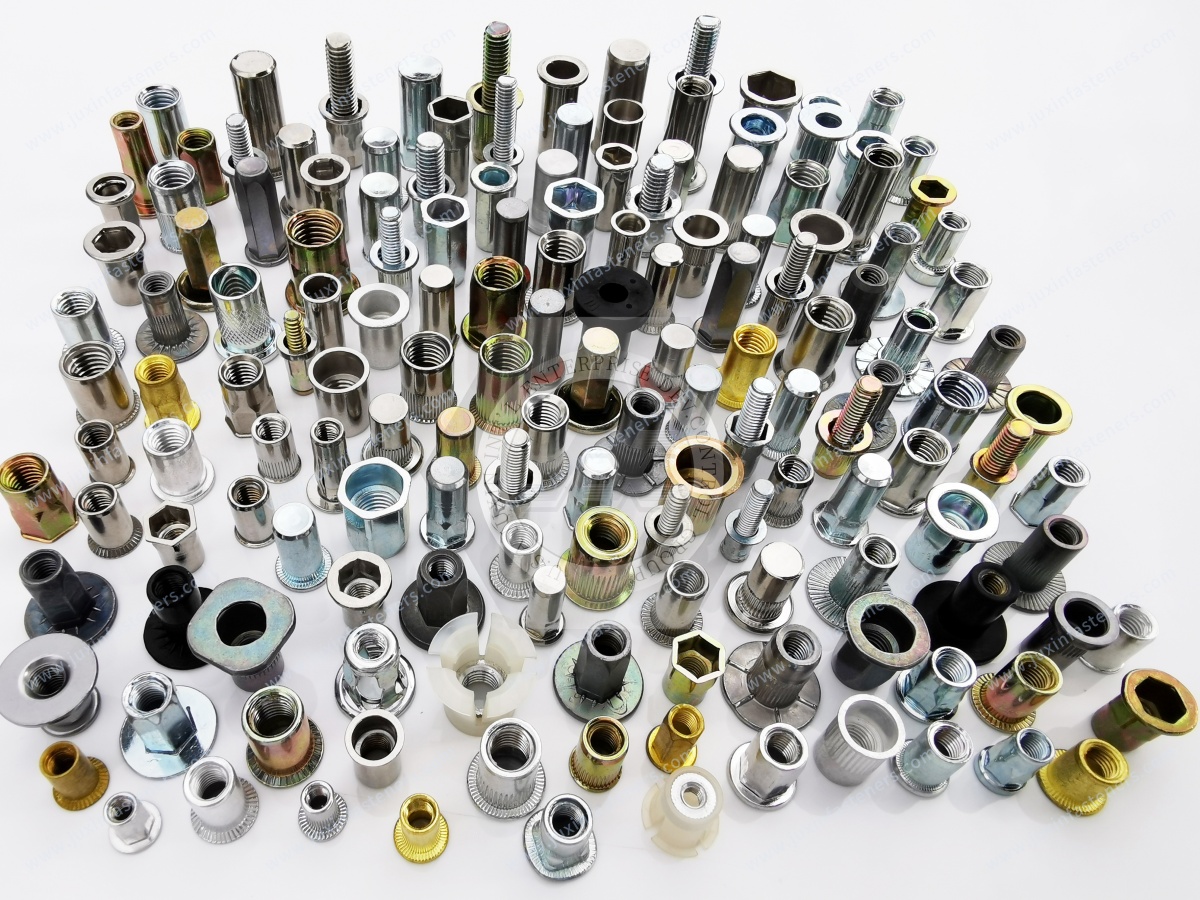
A blind rivet nut is an internally threaded fastener designed to be installed in a prepared hole.
During installation, a setting tool pulls or otherwise deforms the rivet nut body, creating a mechanical upset on the inaccessible side of the panel.
The installed fastener provides a threaded attachment point for a mating screw or bolt.
Principal Features
Internal metal thread
One-sided installation
Mechanical retention in the host material
Reusable threaded interface
Compatibility with selected thin-wall and hollow components
Different body, head and material configurations
How Blind Rivet Nuts Differ from Blind Rivets
A conventional blind rivet normally creates a permanent, non-threaded joint.
A blind rivet nut creates a threaded attachment point, allowing the mating component to be removed and reinstalled.
This difference is particularly relevant for railway equipment requiring maintenance, inspection or replacement.
Important Limitation
A reusable threaded interface does not mean that the rivet nut itself is intended to be repeatedly removed from the panel.
The rivet nut normally remains installed while the mating screw is removed.
Why Railway Manufacturers Use Blind Rivet Nuts
One-Sided Assembly
Railway carbody structures and interior assemblies may contain hollow sections, enclosed profiles and inaccessible cavities.
Blind rivet nuts can provide a threaded connection without requiring rear-side access.
Thin-Wall Fastening
Thin aluminum and steel panels may not provide adequate thread engagement for direct tapping.
A properly selected rivet nut can create a separate internal metal thread.
Maintenance and Serviceability
Railway equipment may undergo periodic inspection, repair, refurbishment and replacement.
A removable bolted interface can simplify access to selected covers and equipment modules.
Post-Fabrication Installation
Blind rivet nuts may be installed after forming, machining or coating operations, provided the installation method and surface condition are compatible.
Reduced Welding Requirements
Mechanical installation avoids the localized welding heat associated with weld nuts.
However, it does not eliminate the need to evaluate panel deformation, hole quality, corrosion or joint strength.
Application Selection: Interior Attachments Versus Structural Connections
Railway fastening applications should be classified according to their mechanical and safety functions.
Noncritical and Auxiliary Attachments
Potential applications include selected:
Interior trim panels
Removable access covers
Electrical cabinet panels
Equipment enclosure covers
Lightweight auxiliary brackets
Serviceable HVAC panels
Cable-management components
These applications may be appropriate for standard or customized blind rivet nuts, subject to engineering validation.
Passenger-Facing and Load-Bearing Interior Equipment
Seat structures, handrails, luggage racks, partition supports and other passenger-facing components can experience significant loading.
A rivet nut may be used only where the approved structural design and qualification process demonstrate suitability.
Primary Carbody and Safety-Critical Connections
Primary load-bearing carbody joints, crash-related structures and other safety-critical interfaces require dedicated structural engineering and approval.
A general-purpose blind rivet nut must not be treated as a direct replacement for a structural weld, structural rivet, lockbolt or other qualified connection.
Engineering Decision
Before selecting a rivet nut, determine whether the joint is:
A removable cover attachment
An auxiliary equipment connection
A load-bearing interior connection
A safety-critical connection
A primary structural connection
The classification determines the level of analysis, testing and approval required.
Blind Rivet Nut Applications in Railway Interiors
Ceiling Panels and Interior Linings
Ceiling and interior lining assemblies may use lightweight panels attached to supporting metal structures.
Potential fastening requirements include:
Removable access
Controlled installed height
Panel alignment
Repeated maintenance
Resistance to service vibration
Engineering Considerations
A low-profile rivet nut may be useful where the head must not interfere with the panel stack-up.
However, reduced-head designs require suitable host material and hole geometry.
Sidewall Panels and Interior Covers
Sidewall assemblies may contain formed sheet metal, aluminum profiles and decorative panels.
Rivet nuts may be used in appropriate supporting structures where reusable threads are required.
The design must consider differential movement, panel flexibility, vibration and installation accessibility.
Passenger Service Equipment
Selected interior equipment may require threaded attachment points for auxiliary brackets and removable components.
Where the attachment carries passenger loads or contributes to safety, the railway OEM must approve the complete connection.
Interior Retrofit and Refurbishment
During rail vehicle refurbishment, access to the rear of an existing panel may be restricted.
Blind rivet nuts can be useful when a properly engineered mounting hole and sufficient host material are available.
Retrofit Limitation
A rivet nut should not be installed into an existing structure without evaluating:
Parent material condition
Remaining section thickness
Existing holes
Corrosion
Edge distance
Structural loading
Modification approval
Electrical Cabinets and Control Enclosures
Railway vehicles contain electrical cabinets, control systems, communication modules and power distribution equipment.
Blind rivet nuts may provide reusable threaded connections for selected:
Cabinet covers
Mounting brackets
Internal equipment panels
Auxiliary supports
Service access components
Engineering Requirements
Dimensional consistency
Suitable corrosion protection
Controlled tightening
Resistance to insert rotation
Maintenance accessibility
Electrical clearance where relevant
Important Electrical Consideration
A metallic rivet nut does not automatically establish a reliable protective bonding or grounding path.
Electrical continuity, coatings, contact resistance and the complete electrical design require separate evaluation.
HVAC and Ventilation Equipment
Railway HVAC systems may include thin sheet-metal housings, duct components, protective covers and serviceable brackets.
Potential rivet nut applications include:
Removable access panels
Filter compartment covers
Auxiliary equipment brackets
Selected duct and enclosure attachments
The required fastener should be chosen according to mechanical loading, service conditions and maintenance requirements.

Aluminum Extrusions and Hollow Railway Profiles
Extruded aluminum profiles are widely used in suitable lightweight assemblies.
Some profiles provide access to only one side of a fastening location.
Blind rivet nuts can create threaded attachment points without requiring a conventional nut behind the profile wall.
Engineering Considerations
Profile wall thickness
Hole location
Hole shape
Local profile geometry
Setting deformation
Anti-rotation performance
Corrosion compatibility
Load transfer
Why Hollow Profiles Require Special Attention
A blind rivet nut must deform correctly inside the available cavity.
The cavity geometry must provide enough space for the fastener's backside upset.
Nearby walls or internal features may interfere with setting.
Blind Rivet Nut Types for Railway Applications
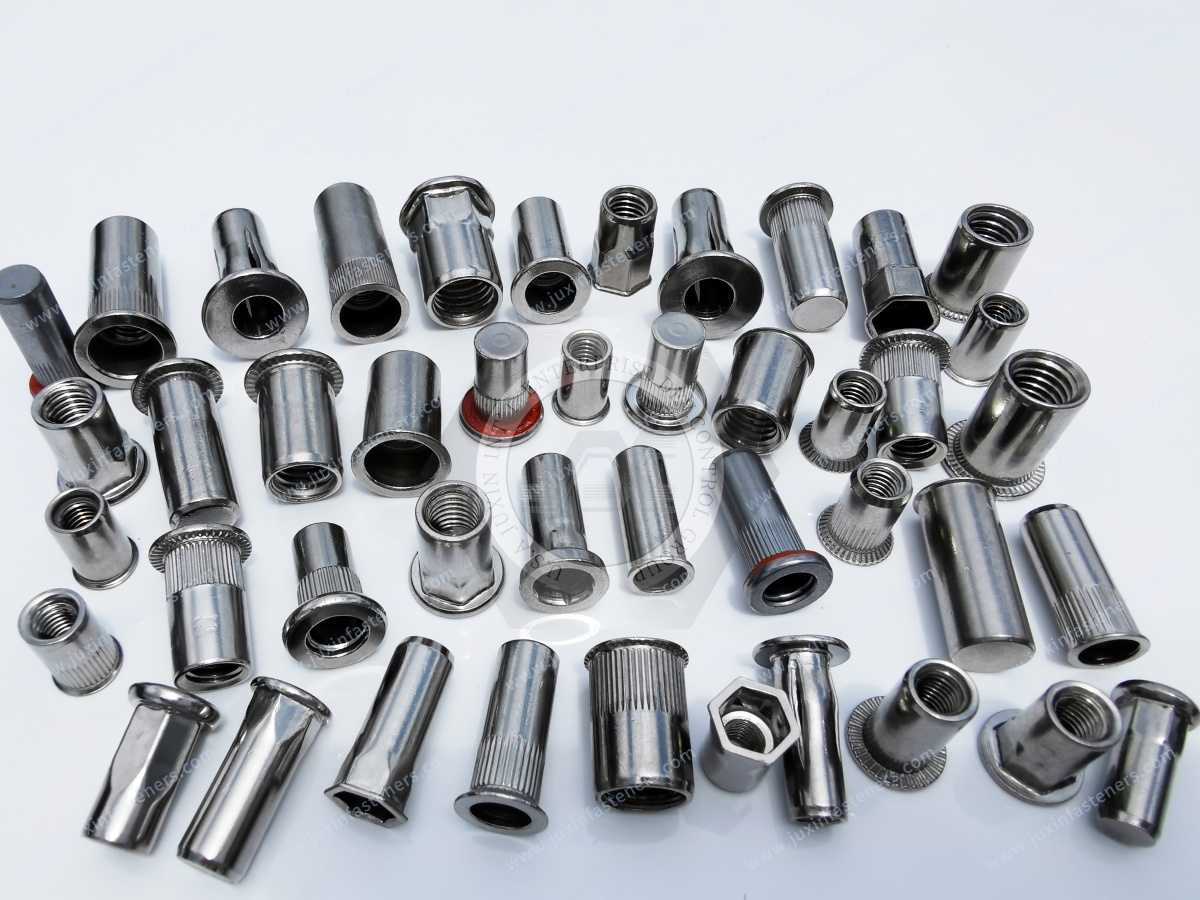
Full-Hexagonal Blind Rivet Nuts
Full-hexagonal rivet nuts are designed for matching hexagonal holes.
The geometric engagement between the body and the hole can provide strong anti-rotation performance in suitable materials.
Potential Applications
Aluminum profiles
Steel panels
Equipment mounting structures
Repeatedly serviced assemblies
Engineering Limitations
A hexagonal body does not guarantee unlimited torque resistance.
Hole tolerances, parent material, installation quality and applied torque remain important.
Half-Hexagonal Blind Rivet Nuts
Half-hexagonal designs combine a hexagonal section with another body geometry.
They may offer useful anti-rotation performance while meeting specific installation or packaging requirements.
Selection Factors
Hole geometry
Available cavity space
Grip range
Setting tool compatibility
Required torque-out resistance
Knurled Round-Body Rivet Nuts
Knurled round-body rivet nuts use external surface features to improve engagement with the host material.
Potential Advantages
Round mounting holes
Compatibility with selected production processes
Improved anti-rotation performance compared with some smooth-body designs
Limitations
Performance depends on the knurl profile, panel material and installation conditions.
Smooth Round-Body Rivet Nuts
Smooth round-body rivet nuts may be appropriate for selected applications where the required retention performance can be achieved.
They should not be assumed suitable for high tightening torque without validation.
Open-End Blind Rivet Nuts
Open-end designs provide a through-threaded configuration.
They may be suitable where the assembly does not require a closed fastener bore.
Closed-End Blind Rivet Nuts
Closed-end designs have a closed body end.
They may help block one potential path for contamination or moisture through the fastener bore.
Important Sealing Limitation
A closed-end rivet nut does not automatically seal the mounting-hole perimeter.
Additional sealing features or joint-level validation may be required.
Structural and High-Strength Rivet Nut Designs
Some engineered rivet nuts are designed for increased mechanical performance.
However, the term structural rivet nut should not be treated as a universal standardized performance classification.
Actual suitability depends on the specific product, joint design, load requirements and qualification results.
Head Styles and Installation Geometry
Common head configurations include:
Flat head
Reduced head
Countersunk head
Flat Head
Provides a defined bearing surface against the parent material.
Reduced Head
May be suitable where low installed height is important.
Countersunk Head
May be used where a recessed or near-flush installation is required, subject to suitable countersink geometry and remaining panel thickness.
Important Design Consideration
A countersink removes material from the host panel.
For thin railway sheet metal, the remaining thickness and local strength must be evaluated.
Choosing the Correct Rivet Nut Material
Carbon Steel Rivet Nuts
Carbon steel may provide a suitable balance of mechanical performance and cost for many interior and equipment applications.
Considerations
Material grade
Thread strength
Corrosion protection
Setting force
Parent material compatibility
Stainless Steel Rivet Nuts
Stainless steel may be appropriate where corrosion resistance or other material requirements are important.
Common stainless steel families include A2 and A4, depending on the actual product specification.
Considerations
Environmental exposure
Material strength
Installation force
Galvanic interaction
Cost
Aluminum Rivet Nuts
Aluminum rivet nuts may be considered for selected lightweight assemblies.
Potential Advantages
Low mass
Compatibility with some aluminum components
Reduced dissimilar-metal concerns in certain designs
Limitations
Thread strength
Mechanical loading
Installation characteristics
Material grade
Material Selection Principle
The strongest material is not automatically the best material.
The correct selection depends on the complete joint and its operating environment.
Corrosion Protection in Railway Vehicles
Railway equipment can experience humidity, condensation, cleaning chemicals, environmental contamination and temperature variation.
Potential Corrosion Risks
General corrosion
Galvanic corrosion
Crevice corrosion
Coating damage
Corrosion around mounting holes
Steel Rivet Nuts
Protective coatings may include zinc or zinc-nickel systems, subject to the approved specification.
Stainless Steel Rivet Nuts
Stainless steel may provide improved corrosion resistance in suitable environments, but the actual grade and conditions must be evaluated.
Aluminum Profiles
Dissimilar-metal contact between steel or stainless steel fasteners and aluminum profiles may require corrosion assessment.
Relevant Testing
ISO 9227 and ASTM B117 describe salt spray test methods.
Salt spray duration alone does not establish a guaranteed railway service life.
The required test conditions and acceptance criteria should be defined by the customer.
Grip Range: Matching the Rivet Nut to the Host Material
The grip range identifies the thickness range for which a particular blind rivet nut is designed.
Why Grip Range Matters
If the host material is too thin, the fastener may not form the intended mechanical retention.
If the material is too thick, the deformable section may not collapse correctly.
Required Engineering Information
Nominal panel thickness
Minimum thickness
Maximum thickness
Coating thickness
Grip range
Hole diameter
Body geometry
No Universal Thickness Range
The grip range varies by model, thread size, material and body design.
A general range such as 0.5–6 mm should not be applied to every railway rivet nut.
The approved drawing or product specification must define the actual range.
Hole Geometry and Preparation
Mounting-hole quality strongly influences rivet nut performance.
Round Holes
May be suitable for smooth or knurled round-body designs.
Hexagonal Holes
May provide geometric anti-rotation engagement for matching hexagonal bodies.
Hole Diameter and Tolerance
Incorrect dimensions can reduce retention or cause installation damage.
Burr Control
Burrs can interfere with seating and damage surface coatings.
Hole Position
Misalignment may cause assembly difficulties or unwanted loading.
Edge Distance
Insufficient edge distance can increase local deformation or tearing risk.
Engineering Recommendation
Hole geometry should be controlled as part of the fastening specification, not left solely to the panel fabrication process.
Round-Hole Versus Hexagonal-Hole Cost Trade-Off
Hexagonal holes can improve anti-rotation performance for suitable fastener designs.
However, hexagonal holes may require additional punching, machining or laser processing.
Round holes may be simpler to produce.
Total Cost Comparison
Hole preparation
Fastener unit price
Installation equipment
Torque-out performance
Scrap
Inspection
Rework
Maintenance
Important Engineering Insight
A specialized round-hole rivet nut may achieve sufficient anti-rotation performance in a particular application.
The most economical solution should be selected based on validated joint performance and total installed cost.
Blind Rivet Nut Installation in Railway Production
Blind rivet nuts are installed using suitable setting tools.
The installation process must produce the required backside deformation without damaging the host material.
Typical Installation Sequence
Prepare the mounting hole.
Confirm the correct rivet nut specification.
Position the fastener.
Apply the approved setting process.
Verify head seating.
Confirm the backside upset where accessible.
Inspect the installed fastener.
Assemble the mating screw or component.
Important Process Variables
Setting stroke
Setting force
Tool alignment
Mandrel condition
Parent material thickness
Fastener material
Fastener geometry
Under-Setting
Insufficient deformation can reduce pull-out and torque-out performance.
Over-Setting
Excessive deformation may damage the fastener, distort the panel or affect thread quality.
Coated and Painted Panels
Blind rivet nuts can be installed into some coated or painted components.
However, the process may still cause local coating damage.
The coating system and installation sequence must be validated.
Automated Installation for Rolling Stock Manufacturing
Production lines may use pneumatic, hydraulic or automated rivet nut setting equipment.
Potential functions include:
Automatic feeding
Fastener orientation
Robotic positioning
Controlled setting
Stroke monitoring
Force monitoring
Installation verification
Manufacturing Engineering Priorities
Tool capability
Process window
Panel variation
Setting consistency
Defect detection
Equipment maintenance
Production Manager Priorities
Assembly cycle time
Accepted output
Rework
Scrap
Changeover time
Tooling maintenance
Operator access
Cost per accepted assembly
Why One-Sided Installation Can Improve Production
Single-sided access can simplify assembly in hollow sections and enclosed structures.
However, the actual productivity improvement depends on the existing process, part handling, tooling and inspection requirements.
No universal time-saving percentage should be assumed.
Vibration and Shock Reliability in Railway Applications
Railway vehicles experience vibration and shock during operation.
The fastening system must be evaluated according to its location, loading and safety function.
IEC/EN 61373
IEC/EN 61373 addresses shock and vibration testing for equipment intended for railway vehicles.
Its application depends on the equipment's mounting location and relevant test category.
Important Distinction
Testing a complete equipment assembly is not the same as testing an individual rivet nut.
A rivet nut should not be described as independently certified to every railway vibration requirement without supporting evidence.
Joint-Level Evaluation
Depending on the application, evaluation may include:
Insert rotation
Axial pull-out
Screw loosening
Clamp-load retention
Panel deformation
Fatigue
Functional inspection after vibration
Why Rivet Nut Retention and Screw Locking Are Different
The rivet nut must remain securely attached to the panel.
The mating screw must maintain the required joint condition.
A rivet nut with strong torque-out resistance does not automatically prevent the screw from loosening.
Screw Tightening and Clamp-Load Control
Correct screw tightening is important for serviceable railway assemblies.
Potential Problems
Excessive tightening torque
Thread stripping
Rivet nut rotation
Panel crushing
Joint relaxation
Screw loosening
Recommended Controls
Specify the mating screw
Define the joint stack-up
Establish appropriate tightening requirements
Validate the bearing surfaces
Consider the effect of coatings
Test the complete assembly
Thread Galling
Certain material combinations, particularly some stainless steel threaded joints, may be susceptible to galling.
The mating materials, surface condition, lubrication requirements and tightening process should be evaluated.
Railway Interior Fire Safety: EN 45545-2
Railway vehicle interiors may be subject to fire protection requirements.
EN 45545-2
This standard addresses the fire behavior of materials and components used on railway vehicles.
Important Engineering Distinction
A metallic rivet nut does not automatically establish compliance for an entire interior assembly.
The relevant requirements may involve:
Decorative panels
Polymeric components
Coatings
Sealing materials
Adhesives
Composite materials
Complete component configurations
Supplier Qualification
Where applicable, the railway OEM should specify the required material documentation and test evidence.
No EN 45545-2 compliance claim should be made without evidence supporting the relevant product and configuration.
Railway Welding Versus Mechanical Fastening
Railway structures may use welding and mechanical fastening for different purposes.
EN 15085 Series
The EN 15085 series concerns welding of railway vehicles and components.
It should not be presented as a blind rivet nut product standard.
Mechanical Fastening Advantages
For suitable joints, rivet nuts may provide:
No welding heat input
One-sided installation
Reusable internal threads
Compatibility with selected preformed components
Mechanical Fastening Limitations
Rivet nuts still require:
Mounting holes
Sufficient host material
Correct setting
Mechanical validation
Corrosion evaluation
Joint approval
Engineering Rule
A welded structural joint must not be replaced with a rivet nut solely to simplify manufacturing.
The replacement requires an appropriate structural assessment and approval.
Railway Quality Management and Supplier Development
Railway manufacturers may require supplier quality systems and project-specific documentation.
ISO 22163:2023
ISO 22163 specifies railway quality management system requirements, incorporating ISO 9001 principles and railway-sector requirements.
IRIS Certification
IRIS Certification is a separate certification scheme with defined assessment requirements.
Compliance with a standard should not be confused with possession of a valid certificate.
Potential OEM Documentation
Approved engineering drawings
Material certificates
Inspection reports
Process documentation
Traceability
Initial sample approval
Test reports
Change-control procedures
Nonconformity management
Important Supplier Statement
Juxin Fasteners' certification status and the scope of any applicable quality approval must be verified separately.
This article does not claim ISO 22163 or IRIS certification.
International Thread Standards
Rivet nuts may be specified with metric or Unified inch threads.
ISO 261
General-purpose ISO metric screw thread series.
ISO 965 Series
ISO metric screw thread tolerances.
ASME B1.1
Unified inch screw threads, including UNC and UNF.
Metric Thread Examples
M3 × 0.5
M4 × 0.7
M5 × 0.8
M6 × 1.0
M8 × 1.25
M10 × 1.5
M12 × 1.75
Unified Inch Thread Examples
1/4-20 UNC
5/16-18 UNC
3/8-16 UNC
These are thread designation examples, not confirmation that every rivet nut configuration is available in every size.
Metric, UNC, UNF, BSW and BSF threads are not directly interchangeable.
The internal thread must match the approved mating screw specification.
Quality Control for Railway Rivet Nuts
A suitable quality plan should address the fastener, host material and completed joint.
Incoming Fastener Inspection
Internal thread
Overall length
Body diameter
Head dimensions
Grip range
Material grade
Surface treatment
Burrs
Visual defects
Host Component Inspection
Panel thickness
Hole dimensions
Hole geometry
Hole position
Coating condition
Edge distance
Installation Process Inspection
Tool alignment
Setting force or stroke
Head seating
Deformation quality
Thread condition
Process consistency
Mechanical Validation
Depending on the application:
Pull-out resistance
Torque-out resistance
Push-out resistance
Screw tightening performance
Vibration testing
Fatigue testing
Corrosion testing
Acceptance Criteria
The test method, sample size and acceptance limits should be defined by the OEM or approved engineering specification.
Common Failure Modes in Railway Rivet Nut Assemblies
| Failure mode | Possible cause | Recommended investigation |
|---|---|---|
| Rivet nut rotates | Insufficient anti-rotation engagement | Review hole, body geometry and setting |
| Rivet nut pulls out | Incorrect grip or insufficient retention | Review thickness and installation |
| Panel deforms | Excessive setting force or weak material | Review tool settings and panel design |
| Thread strips | Incorrect screw or excessive tightening | Review thread and assembly torque |
| Screw loosens | Insufficient preload retention | Review complete bolted joint |
| Corrosion develops | Unsuitable material pairing or coating | Review exposure and protection |
| Coating is damaged | Hole preparation or setting process | Review tooling and finishing |
| Maintenance damage occurs | Incorrect removal or tightening procedure | Review service instructions |
| Fatigue damage develops | Repeated loading or poor load path | Review joint design and testing |
Repair and Maintenance Considerations
Railway equipment may remain in service for many years.
Serviceable fastening systems should be designed with maintenance procedures in mind.
Important Questions
Can the mating screw be removed without damaging the rivet nut?
Is the fastener accessible for inspection?
What happens if the internal thread is damaged?
Can the rivet nut be replaced without damaging the parent structure?
Is the replacement procedure approved?
Are spare parts and specifications controlled?
Engineering Insight
A reusable threaded connection can improve serviceability, but maintenance reliability depends on the complete design and approved procedures.
Custom Blind Rivet Nuts for Railway OEM Applications
Standard rivet nuts may not meet every railway component requirement.
Juxin Fasteners accepts drawing-based inquiries for custom blind rivet nuts, blind rivet studs and related industrial fastening components.
Possible Custom Requirements
Internal thread size
Body diameter
Overall length
Grip range
Head geometry
Full-hex or half-hex body
Round or knurled body
Open-end or closed-end construction
Material grade
Surface treatment
Critical tolerances
Installation equipment compatibility
Packaging and traceability
Why Customization May Be Necessary
An aluminum profile may have limited cavity space.
A decorative panel may require a reduced installed head height.
An electrical enclosure may require a specific corrosion-protection system.
An existing production line may require a compatible fastener geometry.
A railway maintenance project may require an alternative part matching an approved drawing.
Supplier Development and Second-Source Qualification
Procurement teams should not compare rivet nuts using only the internal thread size.
Two M6 rivet nuts can have different:
Body diameters
Grip ranges
Head dimensions
Hole requirements
Materials
Surface treatments
Installation settings
Mechanical performance
Technical Qualification
Approved drawing
Thread specification
Material grade
Grip range
Hole geometry
Mechanical requirements
Installation process
Quality Qualification
Material documentation
Inspection plan
Traceability
Test requirements
Change control
Packaging requirements
Commercial Qualification
Sample quantity
MOQ
Volume pricing
Production lead time
Annual demand
Delivery schedule
Supply continuity
Second-Source Engineering Principle
Matching the internal thread does not establish complete interchangeability.
The alternative fastener must be evaluated in the actual railway component and installation process.
Total Installed Cost for Rolling Stock Manufacturing
The purchase price of a rivet nut is only one part of the overall fastening cost.
Other cost factors may include:
Hole preparation
Setting equipment
Installation cycle time
Operator access
Scrap
Rework
Inspection
Surface protection
Maintenance
Supplier qualification
Packaging and logistics
Production Engineering Decision
The lowest unit-price fastener may not provide the lowest cost per accepted assembly.
The appropriate solution should satisfy the required mechanical performance, installation efficiency and long-term maintenance requirements.
Related Juxin Fasteners Engineering Resources
For more information about available blind fastening configurations, see:
Blind Rivet Nuts and Studs for Single-Sided Fastening
Rivet Nuts Manufacturer — Blind Rivet Nuts for Sheet Metal
These resources cover general blind rivet nut selection and sheet-metal fastening applications.
Frequently Asked Questions
What rivet nuts are suitable for railway interior panels?
Round, knurled, full-hex or half-hex blind rivet nuts may be suitable depending on the host material, grip range, hole geometry and loading requirements.
Can blind rivet nuts be used in aluminum railway profiles?
Yes, suitable designs can provide reusable threads in selected aluminum profiles. Cavity space, hole geometry and installation performance must be evaluated.
Are hexagonal rivet nuts better than round-body rivet nuts?
Hexagonal designs can provide strong geometric anti-rotation engagement, but specialized round-hole designs may also meet certain torque requirements.
The decision depends on validated performance and total cost.
Can rivet nuts replace welding in railway structures?
They may replace some noncritical welded threaded attachments after engineering review, but they are not universal substitutes for structural welds.
Do rivet nuts prevent loosening under railway vibration?
Not automatically. Rivet nut retention and mating screw loosening are separate design considerations.
What is the difference between open-end and closed-end rivet nuts?
An open-end design has a through-threaded body. A closed-end design blocks the body end and may help control contamination through that path.
Are stainless steel rivet nuts always better for railway applications?
No. Material selection depends on corrosion exposure, mechanical requirements, host material and cost.
Does EN 61373 certify a rivet nut?
EN/IEC 61373 addresses shock and vibration testing of railway equipment.
Applicability and testing must be defined for the actual assembly.
Does EN 45545-2 apply to metal rivet nuts?
The standard addresses fire behavior of railway materials and components.
The applicable requirements depend on the component configuration and relevant materials, including any nonmetallic elements.
Can blind rivet nuts be installed automatically?
Yes, suitable rivet nuts can be used with automated setting systems, subject to tool compatibility and process validation.
What information is required for a railway rivet nut quotation?
An approved drawing, thread specification, material, grip range, mounting hole, mechanical requirements, surface treatment,
installation method and purchasing quantity are important starting points.
OEM RFQ — Blind Rivet Nuts for Railway Rolling Stock
Juxin Fasteners welcomes drawing-based inquiries from rolling stock manufacturers, rail vehicle interior system suppliers,
metro and light rail equipment manufacturers, railway electrical equipment companies,
maintenance and refurbishment contractors, mechanical engineers, structural engineers, manufacturing engineers, production managers and global procurement teams.
For technical evaluation and quotation, please provide the following information where applicable.
Fastener Specifications
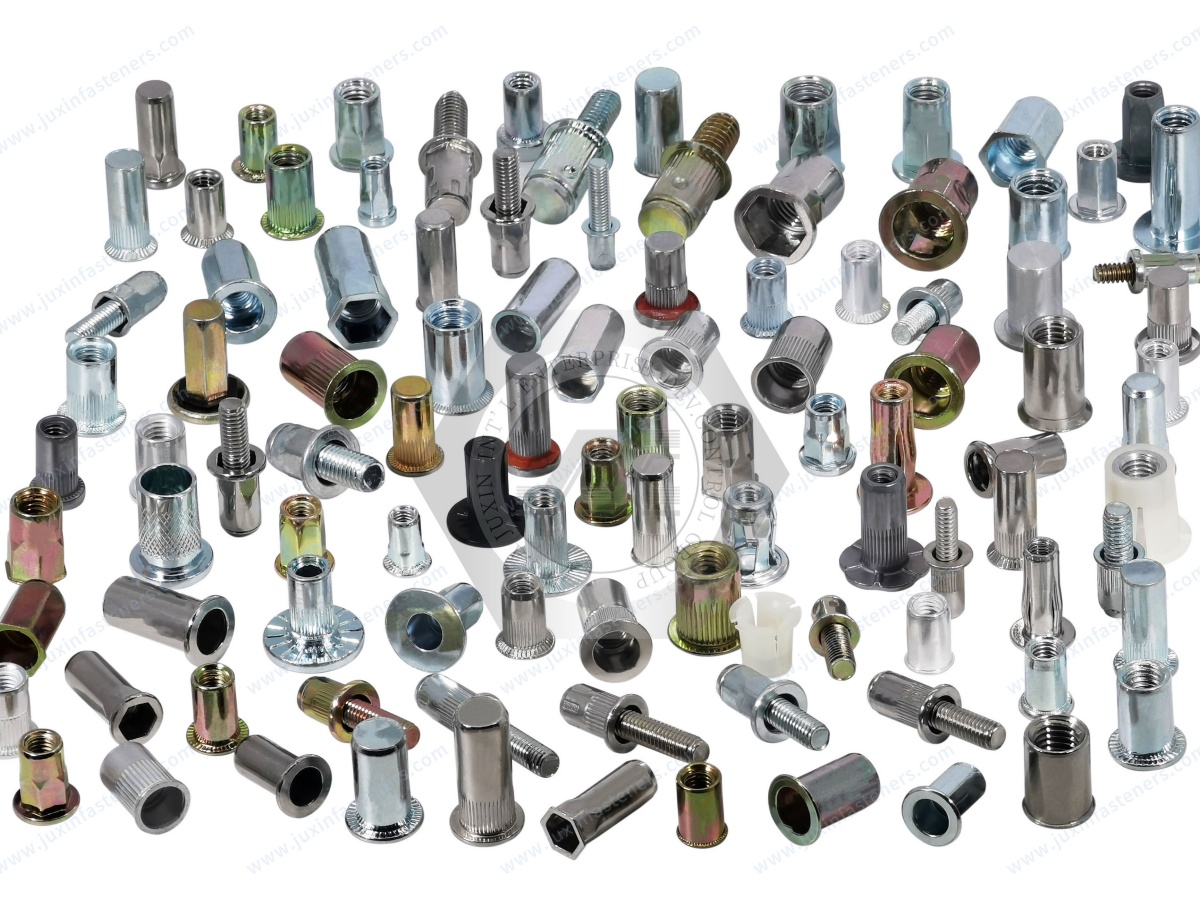
2D engineering drawing
3D CAD model
Internal thread size and pitch
Round, knurled, full-hex or half-hex body
Open-end or closed-end design
Head configuration
Body diameter
Overall length
Grip range
Material grade
Surface treatment
Critical tolerances
Host Component Information
Steel, stainless steel or aluminum grade
Panel thickness
Profile wall thickness
Mounting-hole dimensions
Hole geometry
Available backside clearance
Surface coating
Edge distance
Mechanical Requirements
Pull-out resistance
Torque-out resistance
Push-out resistance
Screw tightening torque
Static loading
Dynamic loading
Vibration and shock requirements
Fatigue requirements
Maintenance cycles
Production Requirements
Manual or automated installation
Setting equipment
Tool compatibility
Setting parameters
Installation access
Production cycle considerations
Inspection method
Quality Requirements
Material documentation
Dimensional inspection
Test reports
Traceability
Customer-specific railway requirements
Initial sample approval
Change-control requirements
Commercial Requirements
Prototype quantity
Sample quantity
Initial order quantity
Estimated annual demand
MOQ expectations
Volume pricing
Required delivery schedule
Packaging requirements
Looking for Blind Rivet Nuts for Railway Rolling Stock and Interior Equipment?
Juxin Fasteners supplies industrial blind rivet nuts, blind rivet studs and drawing-based custom fastening components for suitable railway, transportation and industrial assemblies.
Whether your project involves aluminum profiles, passenger vehicle interior panels, electrical cabinets,
HVAC equipment or serviceable metal enclosures, our team can review your drawings and purchasing requirements.
For safety-critical and load-bearing railway applications, the required engineering qualification and approval must be established by the responsible equipment manufacturer.
Company: Juxin Fasteners
Website: https://www.juxinfasteners.com/
Email: info@juxinfasteners.com
Send your engineering drawings, material specifications, installation requirements and estimated purchasing quantities to request technical evaluation, samples or an OEM quotation.
Reliable railway fastening depends on selecting the correct rivet nut, host material, hole geometry,
installation process and complete joint design—not simply choosing a high-strength fastener.
Contact Us
Tel.:
+86 020 8621 0320
+86 020 3121 6067
E-mail:
Technical Support:
Navigation
SEND INQUIREY



