
Call Us
+86 136 6007 9809
Call Us
+86 136 6007 9809

Sep. 26, 2023
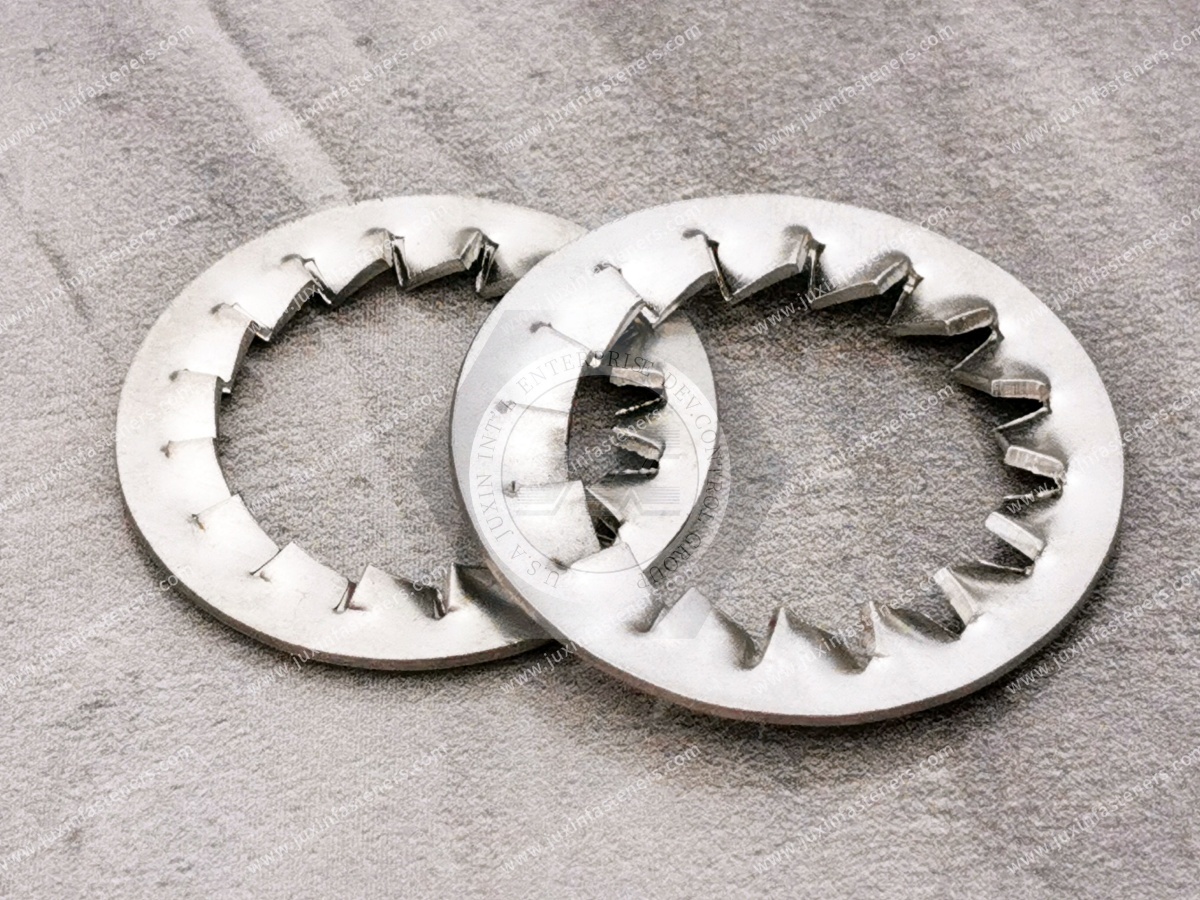
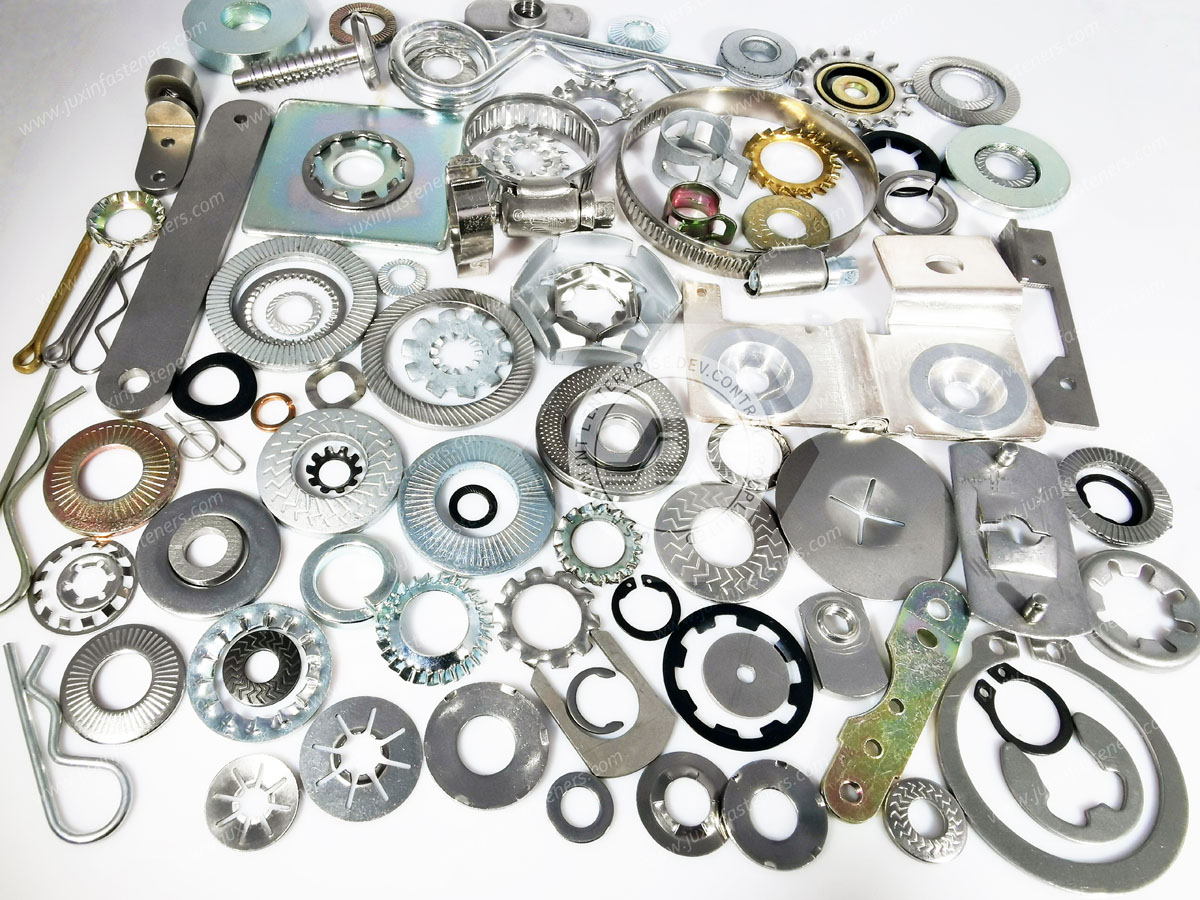
An internal tooth lock washer is a thin mechanical locking washer with multiple teeth arranged around its inside diameter.
It is installed beneath a screw head, bolt head or nut so that the teeth elastically deform and bite into the opposing contact surfaces during tightening.
Internal tooth lock washers are also called internal star washers, internal tooth washers, internal toothed lock washers or Type J tooth lock washers.
Unlike a flat washer, an internal tooth washer is not primarily intended to distribute load over a large area.
Its main function is to increase resistance to rotation by creating localized tooth engagement beneath the fastener.
Internal tooth lock washers are commonly used with smaller screw heads and in assemblies where the outer edge of the washer should remain relatively smooth.
They can be manufactured from hardened spring steel, stainless spring material, copper alloys and other application-specific materials.
JUXIN FASTENERS supplies metric and inch internal tooth lock washers for industrial OEMs,
electrical-equipment manufacturers, automotive suppliers, machinery producers and assembly operations.
Standard and drawing-specific requirements can be evaluated according to dimensions, tooth geometry, material, hardness, finish, corrosion performance and production volume.
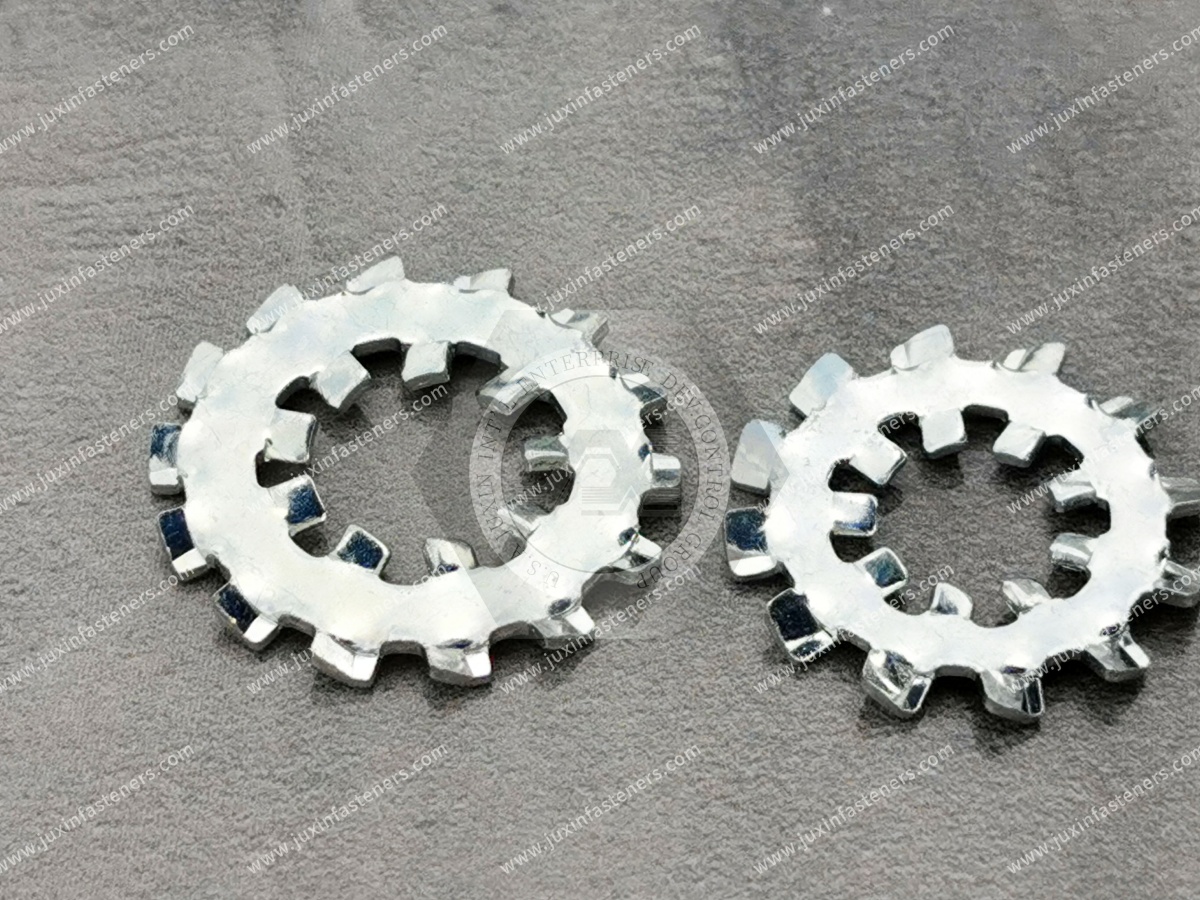
An internal tooth lock washer does not work by filling a gap or by being pressed into a hole.
It is installed as part of a threaded fastener assembly.
During tightening:
The underside of the screw head, bolt head or nut compresses the washer.
The internal teeth elastically deflect.
The tooth edges create localized contact pressure.
The teeth indent or bite into the fastener’s bearing surface and the mating component.
The resulting surface engagement increases resistance to reverse rotation.
The locking effect depends on controlled interaction between:
Tooth hardness
Tooth shape
Fastener-head geometry
Mating-surface hardness
Coating thickness
Installation preload
Surface condition
Direction and severity of dynamic loading
The washer does not produce a positive lock in the same way as a cotter pin, safety wire or bent tab washer. It increases rotational resistance but does not make loosening physically impossible.
For an internal tooth washer to work, its teeth must be compressed between suitable contact surfaces.
Depending on the assembly, the teeth may engage:
The underside of a screw or bolt head
The bearing face of a nut
The upper surface of the clamped component
A conductive metal surface in an electrical bonding assembly
The fastener head or nut must provide sufficient bearing coverage to compress the teeth correctly.
If the head is too small, incorrectly shaped or supported by an incompatible radius, the tooth washer may not seat properly.
If the bearing face does not fully engage the tooth region, the washer can tilt, deform unevenly or fail to provide the intended resistance.
Internal and external tooth washers use a similar tooth-engagement principle, but the location and effective radius of the teeth differ.
| Selection factor | Internal tooth washer | External tooth washer |
|---|---|---|
| Tooth location | Around the inside diameter | Around the outside diameter |
| Outer profile | Relatively smooth | Teeth extend beyond the washer body |
| Typical fastener head | Smaller or compact heads | Wider heads that cover the washer body |
| Locking radius | Closer to the screw axis | Farther from the screw axis |
| Torque resistance potential | Lower mechanical leverage for similar tooth force | Greater leverage due to larger tooth radius |
| Snagging risk | Lower outer-edge snagging risk | External teeth remain exposed |
| Surface marking | Concentrated near the fastener | Distributed at a larger diameter |
| Compact appearance | Often preferred | Less visually contained |
External teeth act at a larger radius and may provide greater resistance to rotation when the fastener head is large enough to engage the washer correctly.
Internal tooth washers are often selected when:
The screw head is relatively small
The washer must remain inside the head outline
Exposed external teeth are undesirable
The outside edge should not catch adjacent components
The application needs localized contact near the screw shank
See the JUXIN FASTENERS guide to external tooth lock washers for a detailed comparison.
“Toothed” and “serrated” are sometimes used interchangeably, but DIN product terminology historically distinguished different geometries.
DIN 6797 J identifies a legacy internal-tooth configuration. The teeth are formed around the inside diameter and elastically engage the contact surfaces.
DIN 6797 has been withdrawn, but the designation remains common in catalogs, legacy drawings and replacement programs.
DIN 6798 J identifies a legacy washer with internal serrations. The serration geometry and contact behavior differ from the DIN 6797 toothed form.
DIN 6798 has also been withdrawn, but the designation remains commercially relevant.
A buyer should not assume that DIN 6797 J and DIN 6798 J are interchangeable. Confirm:
Inside diameter
Outside diameter
Thickness
Tooth or serration count
Tooth angle
Free height
Material
Hardness
Required contact behavior
For DIN 6798 J products, see JUXIN FASTENERS’ internal serrated lock washers.
ASME B18.21.1 covers inch-series helical spring-lock, tooth-lock and plain washers. It includes dimensional requirements, physical properties and related test methods for tooth-lock washers.
For an inch-series RFQ, the purchaser should identify:
ASME B18.21.1
Nominal screw or bolt size
Internal-tooth configuration
Material
Finish
Any supplementary requirements
DIN 6797 J remains a common metric legacy designation for internal toothed lock washers, although the DIN 6797 standard has been withdrawn.
Where a drawing specifies DIN 6797 J, confirm the edition and whether the customer requires exact historical conformity or an approved commercial equivalent.
DIN 6798 J remains a common legacy designation for internally serrated lock washers. DIN 6798 is also withdrawn.
The washer should be sourced against a controlled drawing or dimensional table rather than only the abbreviated standard number.
Automotive, electrical, aerospace, railway and industrial OEMs may use proprietary washer specifications with different requirements for:
Dimensions
Tooth geometry
Hardness
Coating
Electrical performance
Torque resistance
Vibration testing
Traceability
Quality documentation
The customer drawing must take priority when it differs from a general catalog standard.
Internal tooth lock washers can increase resistance to fastener rotation, but they do not guarantee preload retention under every vibration condition.
Their performance depends on whether the teeth maintain effective engagement.
Locking performance may be reduced when:
The mating surface is too hard for the teeth to indent
The surface coating is too thick or too soft
The washer is reused after the teeth have flattened
The fastener preload is too low
The clamped parts slip transversely
The joint settles or creeps
The screw head does not cover the tooth region
The assembly is exposed to severe cyclic shear
The contact surface fractures or flakes
Lubrication changes the achieved preload
For severe transverse vibration, the engineer should compare internal tooth washers with:
Wedge-lock washer pairs
Prevailing-torque nuts
All-metal locknuts
Nylon-insert locknuts
Thread-locking adhesive
Serrated flange fasteners
Tab washers
Safety wire
Cotter pins
Customer-approved positive locking devices
See the broader guide to thread-locking fastener solutions.
The washer teeth must be hard enough to maintain their shape while still being capable of engaging the mating surfaces.
Three conditions are possible.
If the component or fastener bearing surface is significantly harder than the washer teeth, the teeth may slide, polish or flatten instead of biting into the surface.
If the component is soft plastic, thin aluminum, soft copper or an easily deformable coating, the teeth may embed excessively.
This can cause:
Surface damage
Loss of preload
Washer settlement
Material cracking
Reduced locking effectiveness
When washer hardness, tooth geometry and mating surfaces are compatible, the teeth create controlled indentation and increased resistance to reverse rotation.
The correct relationship must be verified for the complete assembly rather than assumed from washer material alone.
Toothed washers are often used because their teeth can penetrate paint, oxide or a surface film. This can support mechanical engagement and, in some cases, electrical contact.
However, penetration of the coating creates tradeoffs:
The protective finish may be damaged
Bare metal may be exposed
Local corrosion can begin
Paint debris may contaminate the assembly
Contact resistance may change over time
Preload can decrease as a soft coating settles
If the coating is important for corrosion protection, the assembly requires an approved repair, sealing or corrosion-control strategy.
A toothed washer should not be installed over a painted surface simply because it appears capable of cutting through the paint.
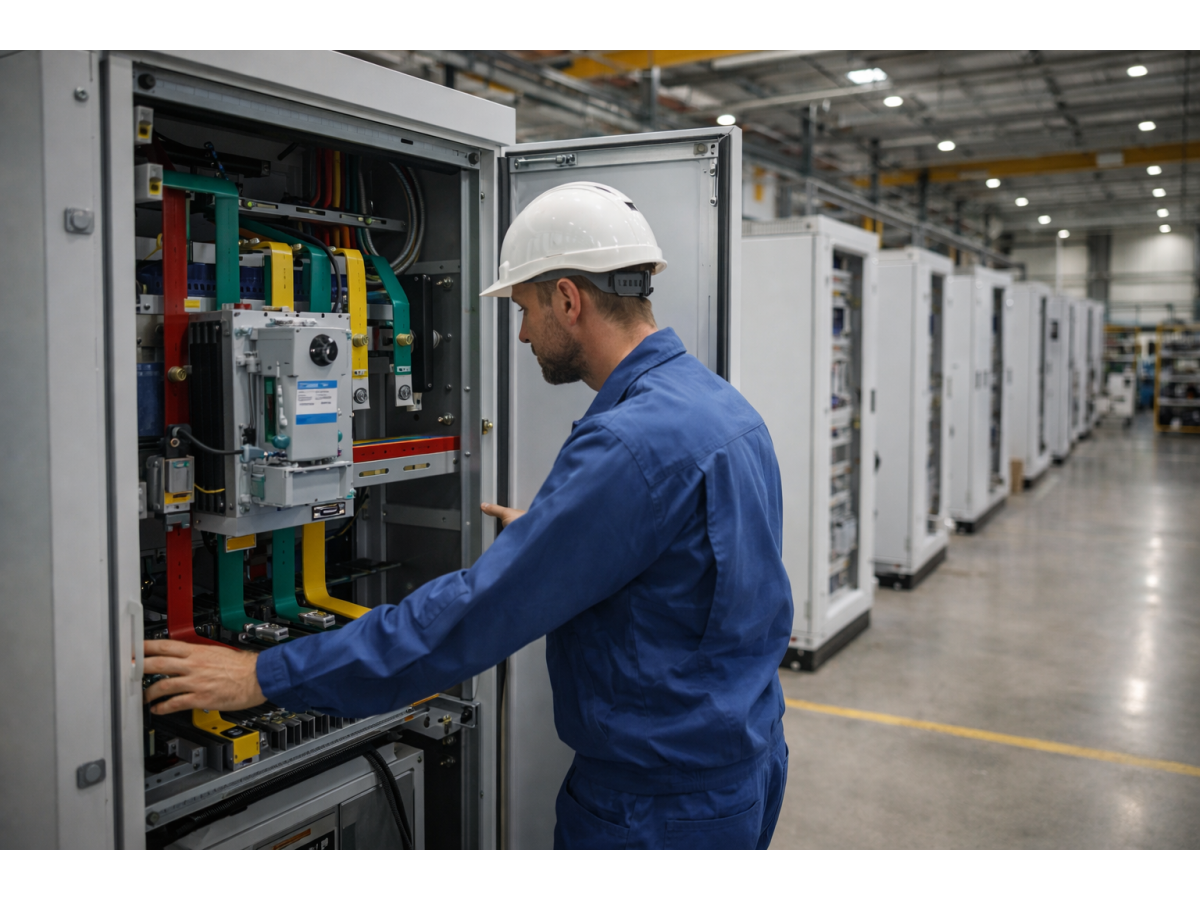
Internal tooth lock washers are frequently used in electrical enclosures, terminal assemblies and grounding connections because the teeth may penetrate surface films and establish metal-to-metal contact.
Potential applications include:
Electrical control cabinets
Chassis bonding
Ground terminals
Panel assemblies
Switchgear
Power supplies
Electronic equipment
Communication equipment
Lighting systems
The washer itself does not guarantee a compliant electrical bond.
Electrical performance depends on:
Base metal
Coating
Contact pressure
Washer material
Tooth engagement
Corrosion
Current level
Thermal cycling
Environmental exposure
Applicable electrical standard
Long-term contact resistance
Grounding and bonding connections should be tested and approved according to the equipment manufacturer’s requirements and applicable safety standards.
An internal tooth lock washer does not distribute pressure as evenly as a correctly sized flat washer.
The teeth intentionally create concentrated contact pressure.
This makes the washer unsuitable for applications where the primary requirement is to protect:
Soft plastic
Decorative surfaces
Fragile coatings
Thin unsupported sheet
Soft aluminum
Composite materials
If both load distribution and locking are required, the assembly may need:
A flange-head fastener
A hardened flat washer
A supported joint surface
A captive washer assembly
A serrated flange component
Another approved locking system
Adding a flat washer between the tooth washer and the mating surface changes the engagement interface and should not be done without engineering review.
Internal tooth washers are often used beneath:
Pan head screws
Cheese head screws
Fillister head screws
Machine screws
Small hex heads
Nuts with suitable bearing faces
Captive screw-and-washer assemblies
Compatibility depends on actual bearing-face diameter rather than the head name alone.
The fastener bearing surface must:
Cover the intended tooth region
Avoid interference with the washer’s inside edge
Seat without contacting an under-head radius
Apply reasonably uniform compression
Remain compatible with the washer hardness
Countersunk screws normally require a washer specifically designed for the countersunk geometry. A conventional flat internal tooth washer should not be forced beneath a conical head.
Hardened spring steel is widely used because it provides:
Elastic tooth deflection
Wear resistance
Tooth strength
Economical high-volume stamping
Compatibility with multiple coatings
The finished washer requires controlled stamping, forming, heat treatment and hardness.
Stainless steel internal tooth washers may be selected for corrosion-sensitive environments.
The material must still provide suitable spring properties. A generic stainless designation does not automatically define:
Hardness
Tooth strength
Elastic recovery
Galling behavior
Corrosion resistance in the actual medium
EN 1.4310 may be considered for stainless spring components. A4-type stainless material may be evaluated for more demanding corrosion exposure, subject to spring-performance requirements.
Copper-alloy washers may be used in selected electrical or non-ferrous assemblies.
Material selection should account for:
Electrical conductivity
Spring properties
Relaxation
Corrosion behavior
Temperature
Galvanic compatibility
Brass, bronze, steel and stainless steel versions should not be treated as mechanically interchangeable without validation.
Available finishes may include:
Black oxide
Zinc plating
Mechanical zinc
Zinc-flake coating
Nickel plating
Phosphate-based finishes
Plain stainless steel
Customer-specified coatings
The finish must be selected according to:
Corrosion environment
Coating thickness
Friction requirement
Electrical conductivity
Contact resistance
Appearance
Hydrogen-embrittlement risk
RoHS and REACH requirements
Customer approval
For hardened spring-steel washers, electroplating processes require appropriate hydrogen-embrittlement controls.
Confirm whether the application requires:
Internal toothed
Internal serrated
External toothed
External serrated
Internal/external tooth
Conical serrated
Countersunk tooth
These designs are not automatically interchangeable.
Verify the inside diameter, outside diameter and tooth region against the screw or bolt.
Remove uncontrolled contamination that could prevent seating or produce an unstable interface.
A specified lubricant or assembly coating should not be removed without approval.
Install the washer beneath the screw head, bolt head or nut specified by the joint design.
A conventional internal tooth washer is not a press-fit retainer and should not be forced into a hole.
Use the torque or preload specification established for the:
Fastener size
Property class
Material
Coating
Lubrication
Joint stiffness
Washer arrangement
Where appropriate, production validation may include inspection of:
Washer seating
Tooth deformation
Surface indentation
Head coverage
Coating damage
Installed torque
Electrical resistance
Reuse is generally not recommended unless specifically permitted and validated.
During the first installation:
Teeth deform
Contact surfaces become indented
Coatings may be penetrated
Tooth edges may flatten
The washer may lose free height
A reused washer may not engage a new surface with the same force or geometry.
For controlled OEM production, maintenance-critical equipment and electrical bonding connections, a new washer is usually the more reliable choice.
An internal tooth lock washer is normally used beneath a threaded fastener. It should not be confused with a push-on retaining washer or star-lock retainer.
The mating surface may be too hard, too smooth or covered with an incompatible coating.
Possible causes include insufficient hardness, incorrect material, excessive load or incompatible fastener geometry.
The concentrated tooth pressure may cut into plastic, aluminum, thin sheet or decorative finishes.
The joint may be experiencing transverse slip, insufficient preload, settlement or vibration beyond the washer’s capability.
Corrosion, coating damage, contamination or reduced contact pressure can degrade an electrical bond.
The teeth can penetrate the protective coating and expose the base material.
If tooth engagement is inadequate, the washer may rotate during tightening and score the surface without producing reliable locking.
Internal tooth washers are widely used in:
Control cabinets
Power-distribution equipment
Terminal assemblies
Electronic enclosures
Lighting equipment
Communication equipment
Power supplies
Instrumentation
Electrical-bonding performance must be validated separately from mechanical locking performance.
Potential applications include:
Machine covers
Control mechanisms
Sensors
Guards
Small brackets
Instrument panels
Serviceable assemblies
They are best suited to light- and moderate-duty connections with compatible bearing surfaces.
Internal tooth washers may be used in approved:
Electrical modules
Interior systems
Lighting assemblies
Sensors
Small brackets
Non-structural accessories
They should not be presented as a universal solution for steering, braking, suspension, restraint or structural battery joints.
Applications may include:
Commercial kitchen equipment
HVAC equipment
Domestic appliances
Pumps
Fans
Heating equipment
Access panels
Material and coating selection should reflect moisture, heat, cleaning chemicals and expected service life.
Compact internal tooth washers may support:
Sensor mounting
Controller assemblies
Small motors
Measurement equipment
Robotic auxiliary systems
Precision enclosures
Where accurate positioning or clean surfaces are required, the effect of tooth indentation must be considered.
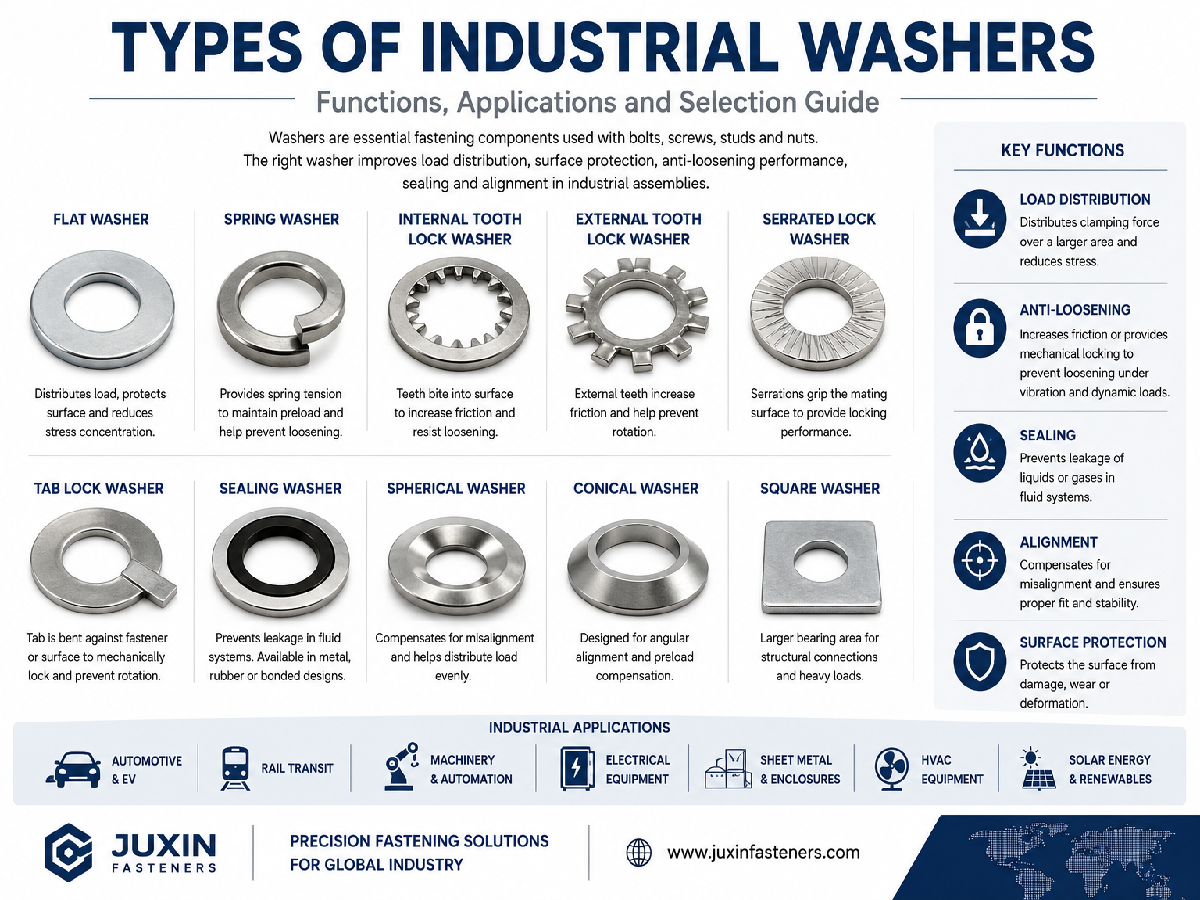
A professional purchasing specification may include:
Applicable ASME, legacy DIN or customer standard
Internal tooth or internal serrated form
Nominal size
Inside diameter
Outside diameter
Thickness
Tooth count
Tooth height
Tooth angle
Free height
Material
Heat-treatment condition
Hardness
Surface finish
Coating thickness
Corrosion requirement
Hydrogen-embrittlement controls
Burr and edge requirements
Crack inspection
Dimensional inspection
Electrical-resistance requirement
Torque-resistance test
Lot traceability
Material certificate
Packaging and labeling
Where locking performance is critical, the customer should define an assembly-level test rather than approving the washer only by dimensions.
To receive an accurate internal tooth lock washer quotation, provide:
Metric or inch fastener size
Applicable standard or customer drawing
Internal toothed or internal serrated form
Washer inside diameter
Washer outside diameter
Thickness
Tooth count and geometry
Fastener-head type and bearing diameter
Washer material
Required hardness
Surface finish
Coating thickness
Mating-surface material
Mating-surface hardness
Paint or coating on the joint surface
Corrosion requirement
Electrical bonding requirement
Vibration or torque-resistance requirement
Inspection and documentation requirements
Prototype quantity
Annual production volume
Packaging and delivery requirements
It is a mechanical washer with teeth around the inside diameter. The teeth deform and engage the fastener bearing face and mating surface during tightening.
No. Its locking action comes from tooth engagement and localized surface indentation, not from filling a gap.
No. A conventional internal tooth lock washer is installed beneath a screw head, bolt head or nut. It should not be confused with a push-on star-lock retainer.
No. Both DIN 6797 and DIN 6798 have been withdrawn, although their designations remain common for legacy parts and replacement sourcing.
ASME B18.21.1 covers inch-series tooth-lock washers, along with other washer types included in that standard.
Neither type is universally better. Internal teeth suit compact heads and a smooth outer profile. External teeth act at a larger radius and may provide greater rotational resistance when correctly engaged.
It may help create metal-to-metal contact, but the completed grounding or bonding connection must be tested and approved according to the equipment requirements.
The teeth may penetrate paint, but this can damage corrosion protection and expose bare metal. The complete joint requires engineering review.
Reuse is generally not recommended because the teeth and contact surfaces deform during the first installation.
Potentially, but the exact stainless spring material, chloride exposure, mating materials and corrosion requirements must be confirmed.
They can increase rotational resistance, but severe transverse vibration may require a more effective locking system validated for the actual joint.
Yes. JUXIN FASTENERS can evaluate customer drawings for non-standard dimensions, tooth geometries, materials, finishes and inspection requirements.
JUXIN FASTENERS supports standard and drawing-specific internal tooth washer requirements for industrial OEM production.
Supply and development options can include:
Metric internal tooth lock washers
Inch internal tooth lock washers
DIN 6797 J-type legacy washers
DIN 6798 J-type internal serrated washers
ASME B18.21.1 inch-series washers
Hardened spring-steel washers
Stainless spring-material options
Copper-alloy and special-material washers
Customer-specific tooth geometry
Controlled heat treatment and hardness
Corrosion-resistant finishes
Dimensional inspection
Material and inspection documentation
Lot traceability
Production packaging
Multi-SKU washer and fastener sourcing
View the internal tooth lock washer product range or submit a drawing for a custom requirement.
A reliable quotation requires more than the nominal screw size.
Send your drawing, applicable standard, fastener-head dimensions, washer dimensions, tooth geometry, material, hardness, finish, mating-surface information,
vibration or electrical requirements, annual quantity and quality-documentation requirements to:
JUXIN FASTENERS supports OEMs, electrical-equipment manufacturers, automotive suppliers, industrial machinery producers and global sourcing teams requiring internal tooth lock washers,
serrated washers and application-specific locking components.
 MORE NEWS
Sep. 27, 2026
Sep. 27, 2026
Sep. 27, 2026
Contact Us
Tel.:
+86 020 8621 0320
+86 020 3121 6067
E-mail:
Technical Support:
Navigation
SEND INQUIREY