
Call Us
+86 136 6007 9809
Call Us
+86 136 6007 9809

Apr. 21, 2026
Insert Nuts for Plastic: Engineering Selection, Installation and OEM Manufacturing Solutions
Threaded inserts for plastic are widely used in industrial assemblies where lightweight polymer components require durable internal metal threads.
Automotive housings, electronic enclosures, medical equipment, electrical assemblies, communication equipment and industrial machinery frequently
use plastic components to reduce weight, simplify molding and provide design flexibility.
However, a plastic housing with a threaded connection must still support the required assembly loads, service conditions and production processes.
Insert Nuts for Plastic, also known as Threaded Inserts for Plastics, provide a metallic internal thread within a properly designed plastic component.
They can support reusable screw connections, improve serviceability and help engineers manage the interface between metal fasteners and polymer structures.
The final performance depends on more than the insert itself.
Plastic resin, boss geometry, installation method, external retention features, mating screw, assembly torque and environmental exposure all influence joint reliability.
For OEM manufacturers, the most effective solution is one that satisfies both engineering performance and repeatable production requirements.
JUXIN FASTENERS supplies industrial threaded inserts, insert nuts and custom fastening components for plastic and engineered assemblies.
This guide explains the major insert types, material choices, design considerations, manufacturing risks and sourcing requirements relevant to global OEM projects.
What Are Insert Nuts for Plastic?
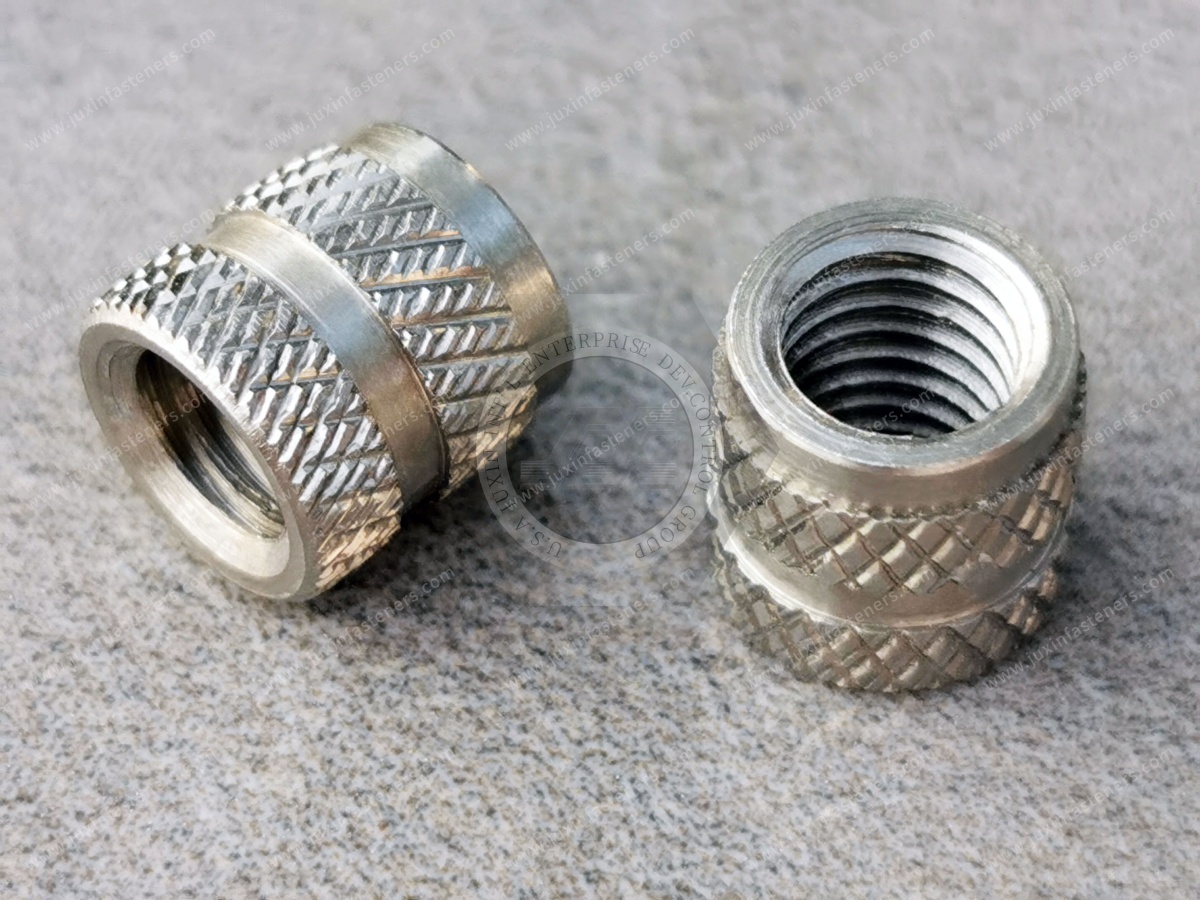
An insert nut is a metallic component installed into a plastic part to provide an internal screw thread.
The insert typically includes:
An internal machine-screw thread
An external retention profile
A defined outside diameter
A specified overall length
A geometry compatible with its installation process
External retention features may include:
Straight knurls
Diamond knurls
Helical knurls
Annular grooves
Undercuts
Barbs
External self-tapping threads
Expansion features
Heads or flanges
These features transfer loads between the metallic insert and surrounding plastic.
Common Industry Terminology
Threaded Inserts for Plastic
Insert Nuts for Plastic
Brass Threaded Inserts
Stainless Steel Threaded Inserts
Heat-Set Inserts
Ultrasonic Inserts
Molded-In Inserts
Press-In Inserts
Self-Tapping Inserts
Expansion Inserts
Threaded Bushings for Plastic
Custom OEM Threaded Inserts
These terms refer to related fastening products, but their external geometry and installation requirements are not necessarily interchangeable.
Why Use Metal Threaded Inserts Instead of Direct Plastic Threads?
Directly molded or formed plastic threads can be appropriate for selected applications.
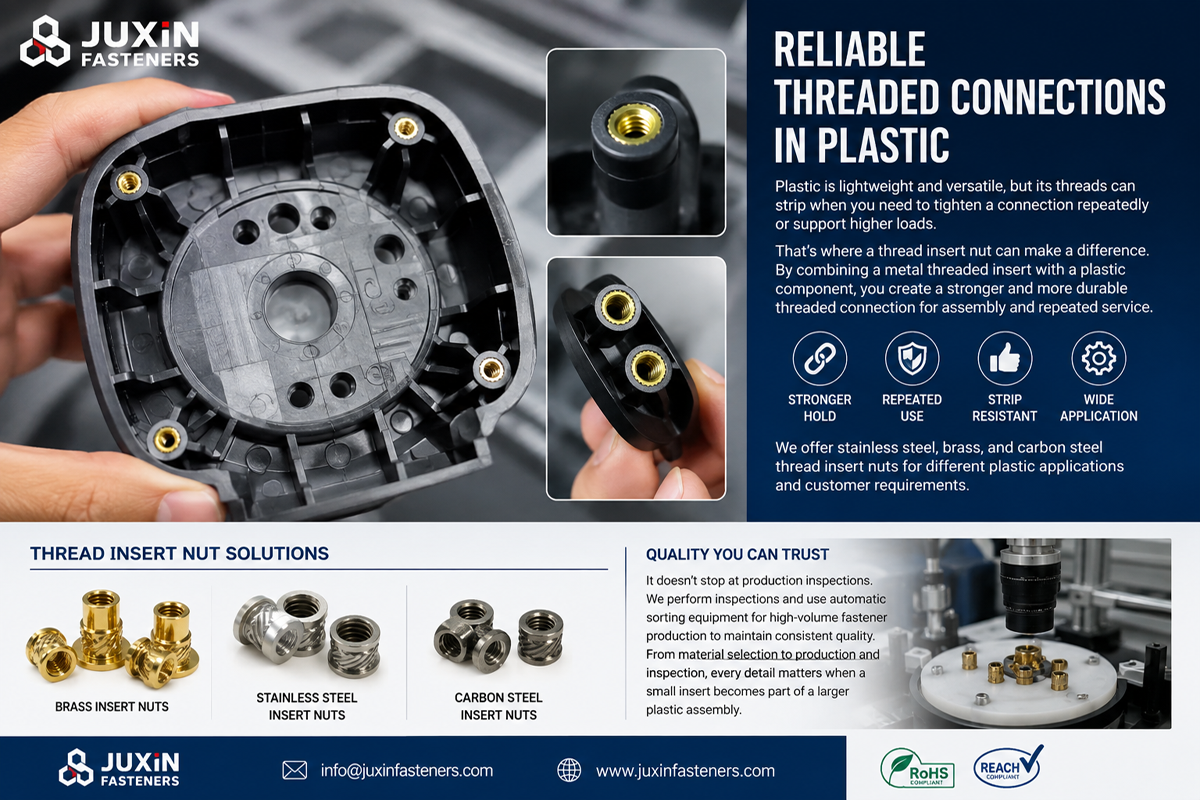
A threaded insert becomes useful when the joint requires characteristics that the plastic thread alone may not provide.
Reusable Assembly
Metallic internal threads can better accommodate repeated screw engagement when the insert and surrounding plastic are correctly designed.
Thread Wear Resistance
The mating screw engages a metallic thread rather than repeatedly contacting a molded plastic thread.
Defined Thread Geometry
A precision insert can provide an internal thread compatible with specified machine screws.
Serviceability
Removable covers and replaceable modules can benefit from reusable threaded connections.
Material Flexibility
The plastic component can retain its molded geometry while the insert provides the required metallic thread interface.
Important Engineering Limitation
A metallic insert does not make the entire plastic component as strong as a metal component.
The surrounding polymer may remain the limiting element.
Likewise, an insert does not automatically prevent vibration loosening, creep, fatigue or boss cracking.
These risks must be addressed through joint design and validation.
Main Types of Threaded Inserts for Plastic
Different insert designs are selected according to polymer type, installation method, required retention and production conditions.
Heat-Set Threaded Inserts
Heat-set inserts are installed into suitable thermoplastics after molding.
A heated tool transfers thermal energy through the insert.
The surrounding plastic softens and flows into the insert's external retention features.
The plastic solidifies as the assembly cools.
Potential Advantages
Reusable metallic threads
Mechanical engagement with the polymer
Compatibility with selected automated equipment
Controlled post-mold installation
Engineering Considerations
Insert temperature
Installation speed
Applied force
Hole diameter
Hole depth
Final seating position
Cooling conditions
Plastic resin and filler content
Typical Applications
Electronic housings
Automotive interior components
Plastic control modules
Industrial equipment enclosures
Important Limitation
Conventional heat-set installation depends on softening thermoplastic.
It is generally not suitable for fully cured thermosetting materials.
Ultrasonic Threaded Inserts
Ultrasonic insertion uses mechanical vibration to generate localized heating at the insert-plastic interface.
The softened polymer flows around the retention geometry and solidifies after installation.
Potential Advantages
Short installation cycles in suitable applications
Localized heating
Compatibility with automated insertion systems
Controlled insertion when the process is validated
Engineering Considerations
Ultrasonic amplitude
Applied force
Process time
Installation travel
Tool alignment
Component support
Polymer characteristics
When Ultrasonic Installation May Be Appropriate
The process may be considered where the resin, insert geometry and production equipment support consistent localized plastic flow.
Why Ultrasonic Is Not Universally Better
Performance depends on the complete assembly.
Some materials and geometries may respond more favorably to thermal insertion or another installation method.
Molded-In Threaded Inserts
Molded-in inserts are positioned in the mold before the plastic is injected or formed.
The polymer flows around the insert and retains it after solidification or curing.
Potential Advantages
Integration into the molding process
Elimination of a separate post-mold insertion step
Compatibility with selected thermoplastic and thermoset applications
Useful for appropriate production architectures
Engineering Considerations
Insert positioning
Mold retention
Plastic flow
Core-pin geometry
Thread protection
Mold cycle time
Tooling maintenance
Insert loading automation
Scrap risk
Why Molded-In Inserts Are Not Always Strongest
Mechanical performance depends on the insert's external geometry, polymer and molding quality.
Molded-in installation should not automatically be ranked above heat-set, ultrasonic or mechanical installation.
Press-In and Cold-Press Threaded Inserts
Press-in inserts are mechanically installed into prepared holes without intentionally melting the surrounding plastic.
They may use:
Barbs
Knurls
Fins
Slotted bodies
Interference-fit geometry
Potential Advantages
No thermal insertion step
Relatively simple installation equipment
Compatibility with selected automated presses
Engineering Considerations
Hole diameter
Interference
Boss wall thickness
Resin stiffness
Insertion force
Alignment
Retention performance
Important Limitation
Cold pressing can generate significant local mechanical stress.
An insert that is too large for the prepared hole may crack the plastic boss.
Self-Tapping Threaded Inserts
Self-tapping inserts use an external thread or cutting/forming geometry to engage the plastic.
They are installed by rotation into a prepared hole.
Potential Advantages
Mechanical installation
No thermal insertion requirement
Suitability for selected thermoplastics and thermosets
Flexible installation for some component designs
Engineering Considerations
Installation torque
Hole diameter
Polymer hardness
External thread geometry
Boss dimensions
Tool alignment
Important Limitation
Self-tapping inserts are not automatically suitable for every reinforced or high-hardness plastic.
The selected geometry must be validated.
Expansion Threaded Inserts
Expansion inserts use a mechanical expansion feature to increase engagement with the surrounding plastic.
Depending on the design, expansion may be activated during installation or through a separate mechanical operation.
Potential Advantages
Mechanical retention without thermal insertion
Compatibility with selected softer plastics
Application-specific installation flexibility
Engineering Considerations
Expansion travel
Plastic deformation
Hole geometry
Boss support
Axial and rotational retention
Important Limitation
Expansion inserts are not interchangeable with conventional press-in or heat-set inserts solely because they have the same internal thread.
How to Select the Correct Installation Method
The selection process should begin with the plastic material and required joint performance.
| Application requirement | Initial insert options | Main validation concern |
|---|---|---|
| Reusable thread in suitable thermoplastic | Heat-set or ultrasonic | Plastic flow and retention |
| Integrated insert during molding | Molded-in | Insert positioning and molding quality |
| Mechanical installation without heat | Press-in | Boss stress and interference |
| Selected thermoset component | Molded-in or compatible mechanical insert | Material fracture and retention |
| Threaded installation into plastic | Self-tapping | Installation torque and boss strength |
| Expansion-based retention | Expansion insert | Local deformation and holding strength |
| High-volume automated assembly | Process-compatible insert | Feeding, cycle time and accepted output |
This table supports preliminary engineering evaluation.
Final selection requires the actual resin grade, component drawing and mechanical requirements.
Brass Threaded Inserts for Plastic
Brass is a widely used material for threaded inserts.
Potential Advantages
Good machinability
Durable metallic threads
Useful thermal conductivity for heat insertion
Availability of different retention geometries
Corrosion resistance in many environments
Common Applications
Electronic housings
Automotive plastic components
Electrical enclosures
Industrial plastic assemblies
Selected medical equipment housings
Brass Alloy Considerations
Different brass alloys have different mechanical properties, chemical compositions and lead content.
The required alloy should be specified according to the application.
Lead-Free and Material Restrictions
A brass insert should not be described as lead-free merely because it is brass.
Where material restrictions apply, the customer should specify the required composition and supporting documentation.
Stainless Steel Threaded Inserts
Stainless steel may be selected where corrosion resistance, environmental exposure or material restrictions justify its use.
Potential Advantages
Corrosion resistance in suitable environments
Durable internal threads
Material options for demanding service conditions
Engineering Considerations
Stainless steel grade
Surface condition
Installation method
Corrosion exposure
Thread behavior
Cost
Important Limitation
Stainless steel is not immune to every corrosive environment.
The actual grade and exposure conditions must be evaluated.
Carbon Steel Threaded Inserts
Carbon steel may be considered where mechanical performance and cost are important.
Engineering Considerations
Material grade
Surface treatment
Corrosion protection
Installation geometry
Thread performance
Service environment
Important Limitation
A high-strength steel insert does not automatically increase the strength of the surrounding plastic boss.
Aluminum Threaded Inserts
Aluminum inserts may be evaluated where low weight or specific material requirements are important.
Engineering Considerations
Alloy
Thread strength
Corrosion behavior
Wear resistance
Surface treatment
Mating screw material
Why Material Selection Must Be System-Based
The insert, polymer, mating screw and operating environment form one mechanical system.
Choosing a more expensive metal does not necessarily improve the finished assembly.
Plastic Materials and Insert Compatibility
Different polymers behave differently during installation and service.
ABS
Often used in molded housings and enclosures.
The insert selection should consider resin grade, molded geometry and environmental exposure.
Polycarbonate (PC)
Used in selected engineering and electronic housings.
Residual stress and chemical compatibility require attention.
PC/ABS
Common in equipment enclosures.
Installation parameters should be based on the actual material grade.
Polyamide (PA6 and PA66)
Moisture absorption can affect dimensions and mechanical properties.
Conditioning may influence insert retention and boss behavior.
Polybutylene Terephthalate (PBT)
Used in selected electrical and automotive components.
The insert design should account for material stiffness, molding behavior and filler content.
Polypropylene (PP)
May be suitable for selected inserts, but its stiffness and creep characteristics must be considered.
Polyoxymethylene (POM)
Has particular friction and dimensional characteristics that can influence mechanical retention.
Polyether Ether Ketone (PEEK)
A high-performance polymer used in selected demanding applications.
Its processing and installation requirements must be evaluated using the actual grade.
Glass-Filled Plastics
Glass reinforcement can change stiffness, shrinkage, local stress behavior and cracking risk.
An insert suitable for unfilled nylon is not automatically suitable for glass-filled nylon.
Thermosetting Plastics
Fully cured thermosets generally cannot be softened using conventional heat-set insertion.
Molded-in or compatible mechanical inserts may be more appropriate.
Why Resin Grade Matters More Than Generic Polymer Names
A specification such as "PA66" or "PC" does not define every relevant characteristic.
Engineers should consider:
Filler content
Resin grade
Moisture conditioning
Molding conditions
Operating temperature
Chemical exposure
Mechanical load
Plastic Boss Design for Threaded Inserts
The plastic boss provides structural support around the insert.
Its geometry influences installation and service performance.
Hole Diameter
The hole must match the selected insert design and installation method.
An oversized hole can reduce retention.
An undersized hole can increase installation force or cause cracking.
Hole Depth
The hole must accommodate the insert and any required clearance.
The mating screw must not bottom out and create unwanted axial force.
Boss Outside Diameter
The boss needs sufficient surrounding material to support installation and service loads.
Boss Height
The boss should accommodate the insert length and intended seating position.
Ribs and Reinforcement
Ribs may improve structural support when correctly designed.
However, poor rib geometry can create molding defects or stress concentrations.
Distance from Edges
An insert located too close to a thin wall or edge may not have sufficient surrounding plastic.
Molded Knit Lines
Weak knit lines near the boss can reduce local mechanical strength.
Why Universal Hole Tolerances Are Misleading
There is no single hole tolerance suitable for every threaded insert.
The correct hole dimensions depend on:
Insert outside diameter
Knurl or retention geometry
Installation method
Polymer grade
Boss dimensions
Mechanical requirements
Industry Engineering Principle
SPIROL's published guidance emphasizes that the correct hole size, tolerance and boss diameter must be selected according to the insert and plastic assembly.
This is more useful than applying one generic tolerance to all products.
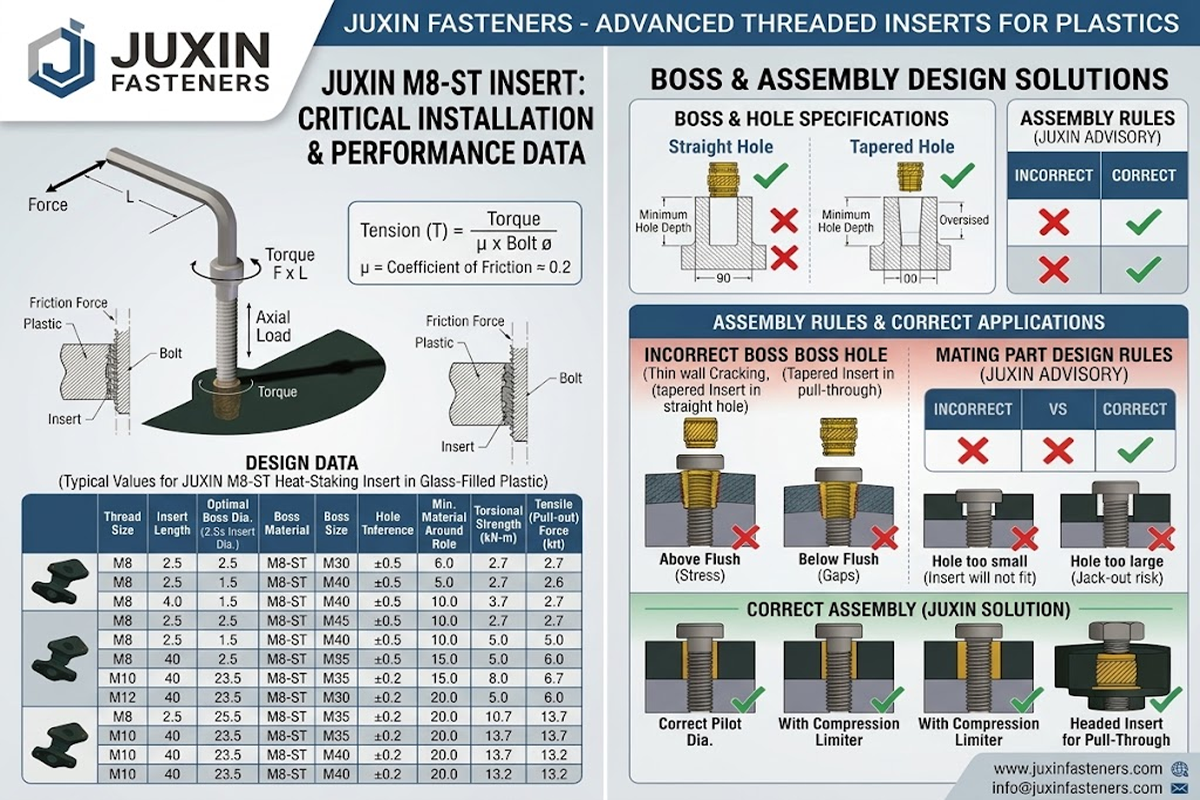
Understanding Pull-Out, Torque-Out and Thread Strength
These characteristics must be evaluated separately.
Pull-Out Resistance
Resistance to axial withdrawal from the plastic.
Torque-Out Resistance
Resistance to rotation within the plastic.
Internal Thread Strength
Resistance of the metallic thread to the specified loading.
Plastic Boss Strength
Ability of the surrounding polymer to transfer loads without unacceptable damage.
Why Published Performance Values Are Not Universal
Retention depends on the actual polymer, boss geometry and installation process.
A catalog test value from one resin should not be assumed to apply to another material.
Recommended Validation
Use production-representative inserts installed in production-representative plastic components.
Test the load directions relevant to the actual application.
Preventing Screw Jack-Out
Jack-out is a potential failure mode when the screw and mating-part geometry create an unintended load that displaces the insert.
Possible Causes
Incorrect screw length
Screw bottoming
Incorrect clearance-hole geometry
Unsuitable insert seating
Poor joint load path
Engineering Controls
Correct screw engagement
Adequate hole depth
Suitable mating-part clearance
Appropriate insert position
Controlled assembly torque
Correct joint geometry
Why the Mating Component Matters
The insert should not be evaluated independently from the screw and attached component.
The complete connection determines how loads are transferred.
Plastic Creep and Long-Term Clamp Load
Plastics may deform under sustained load.
This can affect the clamping force in a bolted joint.
A metallic internal thread does not automatically prevent plastic creep.
Compression Limiters
Where required, a separate compression limiter can help establish a controlled compressive load path.
The threaded insert provides the screw thread.
The compression limiter helps manage compression of the plastic component.
These are related but distinct functions.
Vibration and Repeated Assembly
Threaded inserts may improve the durability of the internal thread during repeated assembly.
However, they do not automatically prevent a screw from loosening under vibration.
Potential Controls
Appropriate tightening torque
Suitable joint design
Correct screw engagement
Application-specific locking features
Validation under expected vibration conditions
Why Repeated Assembly Requires Testing
The number of acceptable assembly cycles depends on the insert, screw, plastic component and loading conditions.
No universal cycle-life claim should be applied without test evidence.
Automated Installation for OEM Manufacturing
High-volume OEM production may use automated insert installation systems.
Depending on the process, equipment may include:
Automatic feeding
Insert orientation control
Heat-setting tools
Ultrasonic equipment
Servo-controlled presses
Position monitoring
Force monitoring
Installation-depth verification
Process data recording
Manufacturing Engineer Priorities
Process capability
Tooling alignment
Installation consistency
Material variation
Inspection strategy
Equipment maintenance
Production Manager Priorities
Cycle time
Accepted output
Equipment uptime
Changeover time
Scrap
Rework
Labor requirements
Cost per accepted assembly
Why the Fastest Insertion Process May Not Be the Best
A faster process can increase total cost if it creates inconsistent retention, cracking or additional inspection.
The objective should be stable, repeatable assembly performance.
Molded-In Versus Post-Mold Installation
For high-volume injection molding, the installation stage affects the entire manufacturing process.
Molded-In Approach
The insert is loaded into the mold before injection.
Potential considerations:
Insert loading time
Mold complexity
Insert retention
Mold protection
Cycle time
Scrap cost
Automation
Post-Mold Approach
The plastic component is molded first.
The insert is installed afterward.
Potential considerations:
Separate installation equipment
Feeding
Installation cycle time
Additional handling
Inspection
Rework flexibility
Why Total Installed Cost Matters
The correct choice depends on annual volume, cavity count, molding architecture, assembly equipment and quality requirements.
The lowest insert unit price does not necessarily produce the lowest finished-assembly cost.
Automotive Threaded Insert Applications
Automotive manufacturers use plastic components in interior systems, electronics and selected functional assemblies.
Potential Applications
Dashboard components
Interior trim assemblies
Lighting housings
Electronic control enclosures
EV auxiliary electronics
Battery-management equipment housings
Engineering Considerations
Temperature variation
Vibration
Polymer creep
Assembly repeatability
Service access
Material compatibility
For safety-critical automotive components, the OEM must define the required validation and approval process.
Medical Equipment Threaded Insert Applications
Threaded inserts may be considered for selected non-patient-contact equipment components.
Potential Applications
Diagnostic instrument housings
Laboratory equipment enclosures
Monitoring equipment covers
Serviceable electronic modules
Auxiliary equipment brackets
Engineering Considerations
Material documentation
Cleaning exposure
Assembly reliability
Traceability
Supplier change control
Important Limitation
Use in a medical equipment housing does not automatically establish medical-grade certification, biocompatibility or sterilization compatibility.
These requirements depend on the finished device and intended application.
Electronics and Communication Equipment
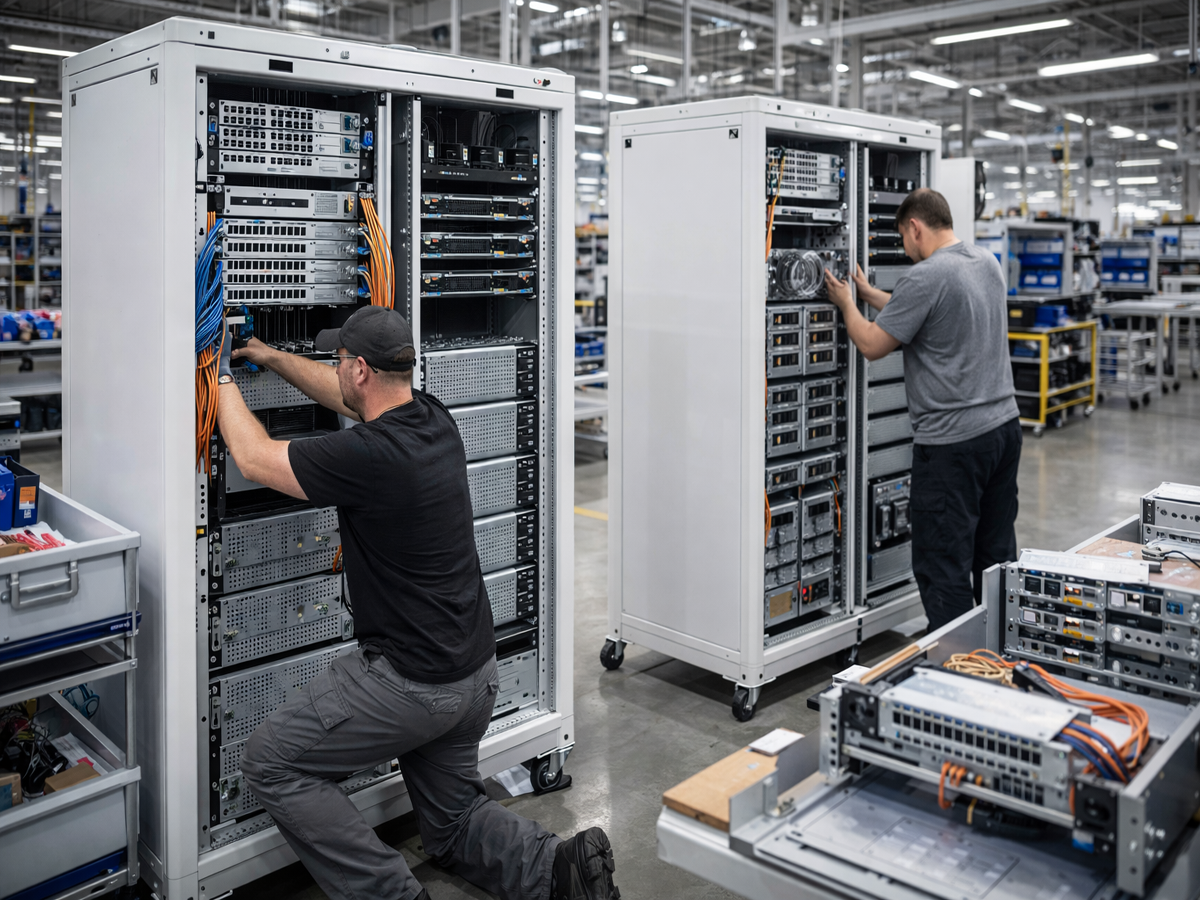
Electronic products often require compact, serviceable threaded connections.
Potential Applications
Industrial electronic housings
Communication equipment enclosures
Server and networking equipment components
Control modules
Sensor housings
Power electronics auxiliary covers
Engineering Considerations
Limited boss space
Dimensional accuracy
Assembly accessibility
Electrical requirements
Thermal exposure
Repeated maintenance
Industrial Electrical Equipment
Plastic threaded inserts may be used in selected insulating housings, covers and support components.
Potential Applications
Electrical control enclosures
Power distribution auxiliary housings
Industrial automation components
UPS equipment covers
Instrumentation assemblies
Engineering Considerations
Electrical insulation requirements
Material temperature rating
Clearance and creepage design
Mechanical loading
Assembly torque
A metallic insert can influence electrical behavior and must be considered within the complete product design.
Industrial Machinery and Robotics
Industrial equipment may require durable fastening points in molded plastic covers and components.
Potential Applications
Machine guards
Sensor mounts
Control panels
Robot auxiliary housings
Instrument enclosures
Engineering Considerations
Vibration
Maintenance access
Chemical exposure
Repeated assembly
Installation reliability
Aerospace and Other High-Reliability Applications
Threaded inserts may be evaluated for selected lightweight equipment and noncritical plastic assemblies.
However, aerospace applications can require extensive material, process, traceability and qualification controls.
Suitability cannot be assumed from ordinary industrial product specifications.
Common Threaded Insert Failure Modes
Insert Pull-Out
Possible causes:
Inadequate retention geometry
Incorrect hole size
Weak boss
Excessive axial load
Insert Rotation
Possible causes:
Poor knurl engagement
Oversized hole
Incorrect installation
Excessive tightening torque
Plastic Boss Cracking
Possible causes:
Excessive interference
Insufficient surrounding plastic
Brittle resin behavior
Weak molded knit lines
Insert Misalignment
Possible causes:
Incorrect hole position
Poor fixturing
Tool misalignment
Insert feeding problems
Incorrect Installation Depth
Possible causes:
Poor travel control
Incorrect tooling setup
Variation in hole depth
Equipment wear
Thread Damage
Possible causes:
Incorrect mating screw
Cross-threading
Excessive torque
Burrs or dimensional defects
Loss of Clamp Load
Possible causes:
Plastic creep
Stress relaxation
Incorrect load path
Unsuitable assembly conditions
Corrosion or Surface Damage
Possible causes:
Incorrect material selection
Aggressive chemical exposure
Inadequate surface treatment
Environmental conditions
Recommended Failure Investigation
Evaluate three separate areas:
The Insert
Material, geometry, thread and surface condition.
The Plastic Component
Resin grade, hole dimensions, boss geometry and molding quality.
The Installation Process
Equipment, alignment, force, temperature, travel and inspection.
Corrective actions should be verified using the actual assembly.
Quality Assurance for OEM Threaded Inserts
A practical quality strategy should cover incoming inserts, plastic components and the installation process.
Incoming Insert Inspection
Depending on the approved drawing:
Internal thread size
Thread pitch
Thread tolerance
Overall length
Outside diameter
Knurl geometry
Head or flange dimensions
Material grade
Surface finish
Burrs and visible defects
Plastic Component Inspection
Hole diameter
Hole depth
Boss dimensions
Hole position
Visible molding defects
Installation Process Control
Tooling setup
Installation temperature or force
Installation travel
Alignment
Equipment condition
Process records
Post-Installation Verification
Insert presence
Installation depth
Position
Visible damage
Thread accessibility
Required mechanical testing
Inspection Frequency
Inspection frequency and acceptance criteria should be defined according to application risk, customer requirements and process capability.
A general statement of 100% inspection or a fixed defect rate is not a substitute for an approved control plan.
International Thread Standards
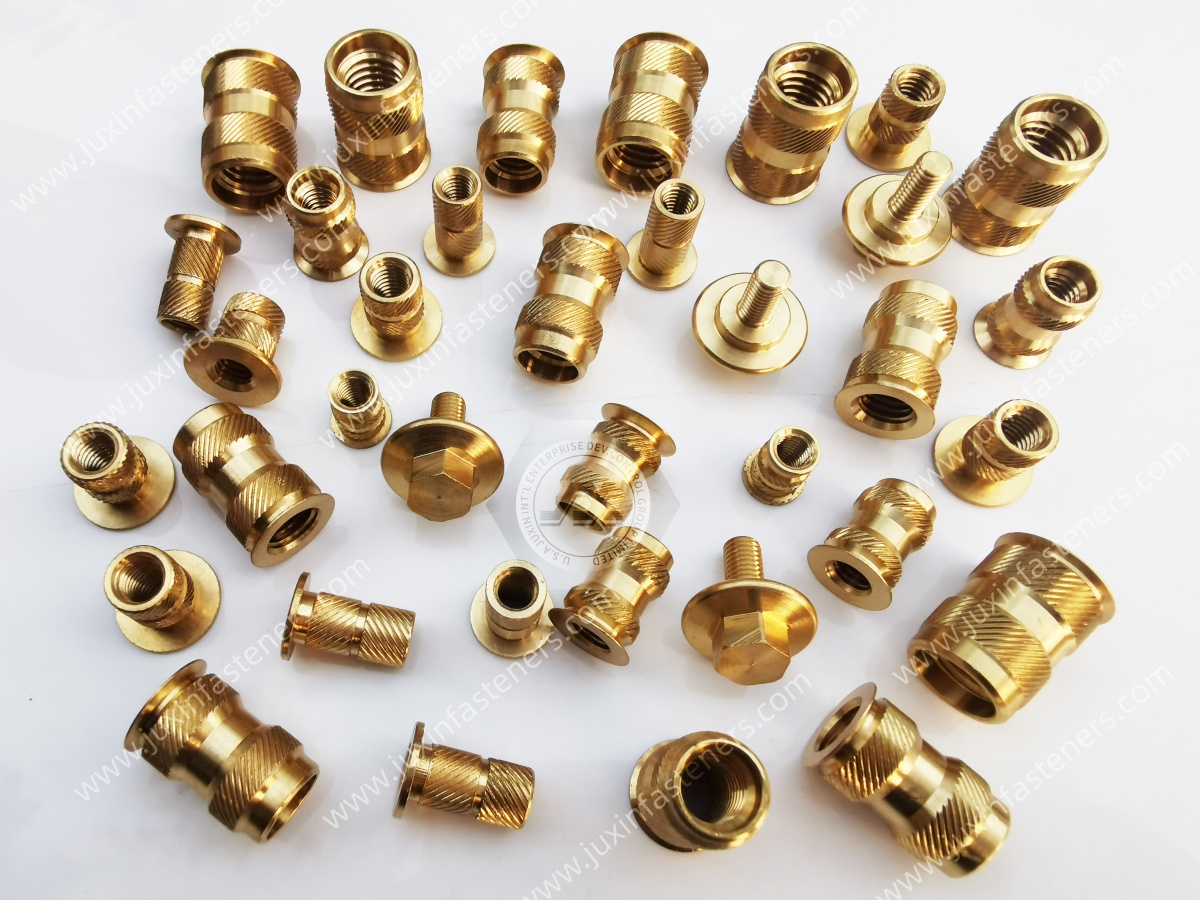
Threaded inserts for plastic are typically specified through product drawings, internal thread standards and application-specific requirements.
There is no single universal ISO or DIN product standard covering every heat-set, ultrasonic, molded-in, press-in, self-tapping and expansion insert geometry.
ISO 261
General-purpose ISO metric screw thread series.
ISO 965 Series
ISO metric screw thread tolerances.
ASME B1.1
Unified inch screw threads, including UNC and UNF.
Metric Thread Examples
M2 × 0.4
M2.5 × 0.45
M3 × 0.5
M4 × 0.7
M5 × 0.8
M6 × 1.0
M8 × 1.25
Unified Inch Thread Examples
2-56 UNC
4-40 UNC
6-32 UNC
8-32 UNC
10-24 UNC
10-32 UNF
1/4-20 UNC
5/16-18 UNC
These are examples of thread designations and do not confirm availability in every insert design.
Metric, UNC, UNF, BSW and BSF are different thread systems and must not be treated as directly interchangeable.
Custom Threaded Inserts for OEM Plastic Components
Standard catalog inserts may not fit every application.
JUXIN FASTENERS supports drawing-based inquiries for custom threaded inserts.
Possible Customization Requirements
Internal thread size and pitch
Outside diameter
Overall length
Thread depth
Knurl configuration
Retention grooves
Undercuts
Barbs
Flanges
Tapered pilot geometry
Blind or through-thread configuration
Material grade
Surface treatment
Dimensional tolerances
Automatic feeding requirements
Why Custom Geometry Can Be Necessary
A plastic housing may have limited boss diameter.
A reinforced polymer may require a different retention profile.
An automated production line may require a particular insertion orientation.
A high-volume OEM program may prioritize total installed cost.
The insert should be selected according to the complete component and manufacturing process.
OEM Supplier Qualification and Second-Source Evaluation
Procurement and supply chain teams should evaluate more than unit price and internal thread size.
Technical Evaluation
Approved drawing
Material grade
Thread specification
External retention geometry
Installation method
Critical tolerances
Mechanical requirements
Quality Evaluation
Inspection methods
Material documentation
Traceability requirements
Nonconforming product controls
Change notification
Agreed test records
Commercial Evaluation
Sample quantity
Minimum order quantity
Price breaks
Lead time
Annual volume
Packaging
Delivery requirements
Supply continuity
Why Equivalent Threads Do Not Mean Equivalent Inserts
Two M5 inserts may have identical internal threads but different external diameters, knurls, materials and installation requirements.
A replacement insert should be evaluated in the actual plastic component and production process.
Total Cost of Ownership
The total installed cost may include:
Insert purchasing
Plastic molding
Installation equipment
Assembly cycle time
Scrap
Rework
Inspection
Tooling maintenance
Supplier qualification
Packaging and logistics
The lowest insert price may not produce the lowest accepted-assembly cost.
JUXIN FASTENERS Threaded Insert Solutions
JUXIN FASTENERS supplies industrial threaded inserts and related fastening components for plastic assemblies.
Relevant product categories include:
Brass Threaded Inserts
Stainless Steel Threaded Inserts
Carbon Steel Threaded Inserts
Aluminum Threaded Inserts
Heat-Set Inserts
Ultrasonic Inserts
Molded-In Inserts
Press-In Inserts
Self-Tapping Inserts
Expansion Inserts
Custom Threaded Bushings
Specific dimensions, materials, finishes, inspection arrangements and commercial terms require project-level confirmation.
Related JUXIN FASTENERS Products and Engineering Resources
Custom Threaded Inserts for OEM Plastic Components
How to Choose Threaded Inserts for Injection Molded Parts
Molded-In vs. Post-Mold Threaded Inserts for High-Volume Manufacturing
Threaded Inserts for Plastic Housings: Heat-Set, Ultrasonic and Molded-In Guide
These resources provide additional information for specific installation methods, plastic component designs and OEM sourcing requirements.
Frequently Asked Questions
What are insert nuts for plastic?
They are metallic threaded components installed into plastic to provide reusable internal screw threads.
Are insert nuts and threaded inserts the same?
The terms are often used interchangeably in commercial searches, although specific designs and installation methods may differ.
Which material is best for threaded inserts?
The correct material depends on mechanical requirements, corrosion exposure, installation method and cost.
Are brass inserts suitable for all plastics?
No. Compatibility depends on the polymer, insert geometry and installation process.
Can threaded inserts be installed in thermosetting plastics?
Selected molded-in or mechanical inserts may be suitable. Conventional heat-set installation generally requires thermoplastic softening.
Which is stronger: heat-set or molded-in inserts?
Neither method is universally stronger. Performance depends on the actual design and material.
What causes threaded insert pull-out?
Potential causes include insufficient retention, incorrect hole geometry, weak plastic bosses or excessive axial loading.
What causes threaded insert rotation?
Potential causes include poor external engagement, incorrect installation or excessive tightening torque.
Can threaded inserts prevent screw loosening?
Not automatically. Joint design and locking requirements must be evaluated separately.
Do threaded inserts prevent plastic creep?
No. The surrounding polymer can still deform under sustained loading.
What is the correct hole diameter for an M5 insert?
There is no universal diameter. It depends on the selected insert design and plastic material.
Can metric inserts replace UNC inserts?
No. Different thread systems must be specified and verified separately.
Can threaded inserts be used in medical equipment?
They may be suitable for selected applications, subject to the finished device's engineering and regulatory requirements.
Can JUXIN FASTENERS supply custom threaded inserts?
JUXIN FASTENERS accepts drawing-based OEM inquiries for custom threaded inserts and related fastening components.
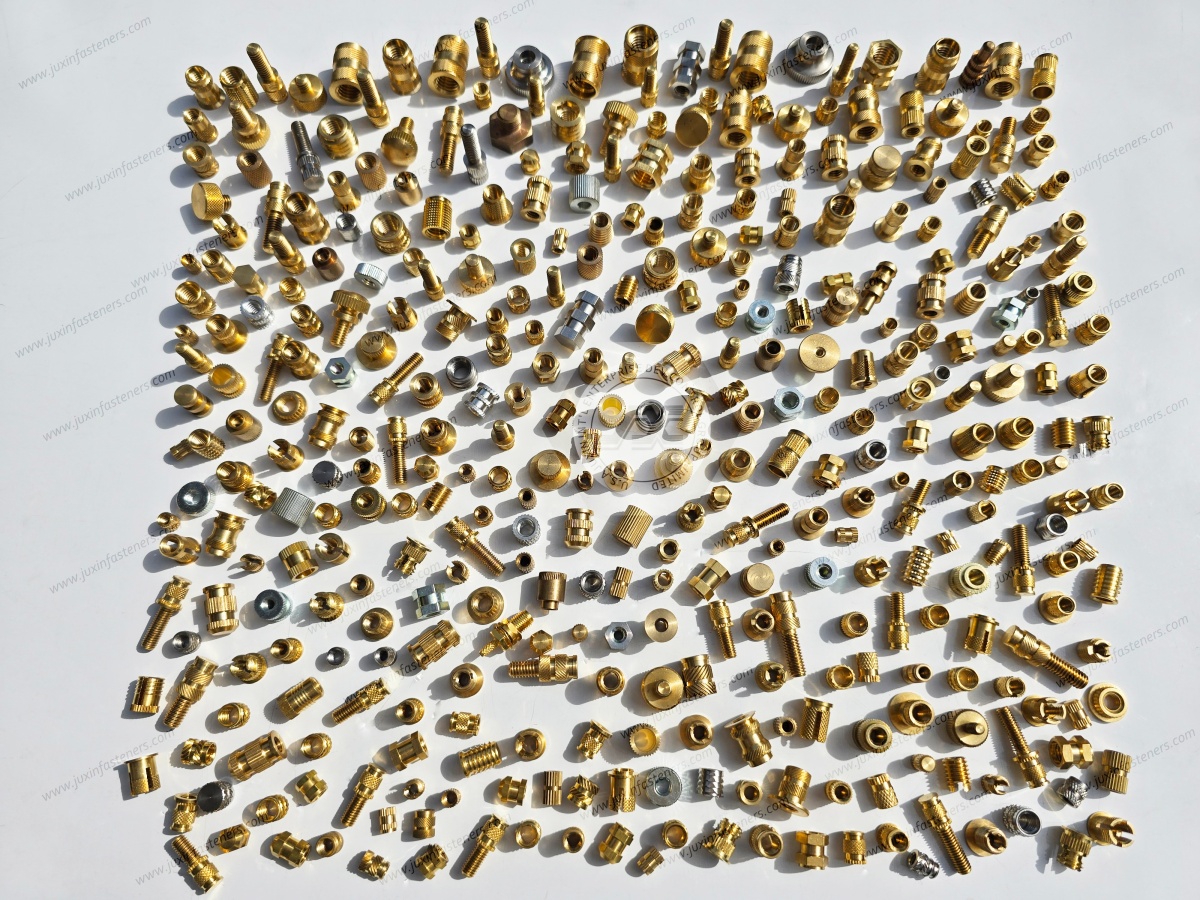
OEM RFQ — Threaded Inserts for Plastic and Engineering Applications
JUXIN FASTENERS welcomes inquiries from OEM manufacturers, plastic injection molding companies, automotive suppliers,
medical equipment manufacturers, electronics manufacturers, industrial equipment producers, engineering teams,
production managers, procurement specialists and supplier development teams.
For technical evaluation and quotation, please provide the following information where applicable.
Insert Drawing and Specifications
2D engineering drawing
3D CAD model where available
Internal thread size and pitch
Metric or Unified inch thread designation
Outside diameter
Overall length
Knurl or retention geometry
Head or flange design
Material grade
Surface treatment
Critical tolerances
Plastic Component Information
Resin grade
Filler content
Hole diameter and tolerance
Hole depth
Boss diameter and height
Wall thickness
Mating component geometry
Installation Requirements
Heat-set, ultrasonic, molded-in, press-in, self-tapping or expansion method
Installation equipment
Required seating depth
Automatic feeding requirements
Production cycle considerations
Mechanical and Environmental Requirements
Pull-out resistance
Torque-out resistance
Assembly tightening torque
Repeated assembly requirements
Temperature
Humidity
Vibration
Chemical exposure
Required testing
Quality Requirements
Inspection criteria
Material documentation
Traceability
Packaging requirements
Change-control requirements
Applicable customer specifications
Commercial Requirements
Prototype or sample quantity
Initial order quantity
Estimated annual demand
MOQ expectations
Delivery schedule
Target purchasing requirements
Company: Juxin Fasteners
Website: https://www.juxinfasteners.com/
Email: info@juxinfasteners.com
Contact JUXIN FASTENERS with your engineering drawings and application requirements to discuss brass threaded inserts, stainless steel inserts,
heat-set inserts, ultrasonic inserts, molded-in inserts, press-in inserts and custom OEM threaded fastening solutions.
Reliable plastic fastening begins with the correct insert geometry, compatible polymer, appropriate installation process and verified joint performance.
Contact Us
Tel.:
+86 020 8621 0320
+86 020 3121 6067
E-mail:
Technical Support:
Navigation
SEND INQUIREY



