
Call Us
+86 136 6007 9809
Call Us
+86 136 6007 9809

Apr. 21, 2026
Press-Fit Brass Threaded Inserts for Medical Equipment: Precision Cold-Press Fastening Solutions for Injection-Molded Plastics
Medical equipment manufacturers use injection-molded plastic components in diagnostic instruments, laboratory equipment,
electronic enclosures, monitoring systems and serviceable equipment housings.
These components often require reusable threaded connections for attaching covers, brackets, internal assemblies and mounting hardware.
Directly formed plastic threads may be suitable for certain applications. However, repeated screw installation,
defined tightening loads or frequent maintenance can justify a metallic threaded interface.
Press-Fit Brass Threaded Inserts, also known as Press-In Brass Thread Insert Nuts or Cold-Press Brass Inserts for Plastics,
provide reusable internal threads within appropriately designed plastic components.
Unlike heat-set or ultrasonic inserts, press-fit designs are installed mechanically, without deliberately heating the surrounding polymer.
Their performance depends on the insert's external retention geometry, plastic resin, molded hole dimensions, boss design, installation conditions and service loads.
For medical equipment OEMs, a successful design must also consider assembly cleanliness,
documentation, traceability, production consistency and the finished device's intended use.
JUXIN FASTENERS supplies industrial threaded inserts and drawing-based fastening components for OEM plastic assemblies.
This guide explains how design engineers, manufacturing engineers,
production managers and procurement teams can evaluate press-fit brass threaded inserts for selected medical equipment applications.
What Are Press-Fit Brass Threaded Inserts?
A press-fit brass threaded insert is a metallic fastener designed to be mechanically installed into a prepared hole in a plastic component.
The insert provides an internal screw thread and uses external retention features to engage the surrounding polymer.
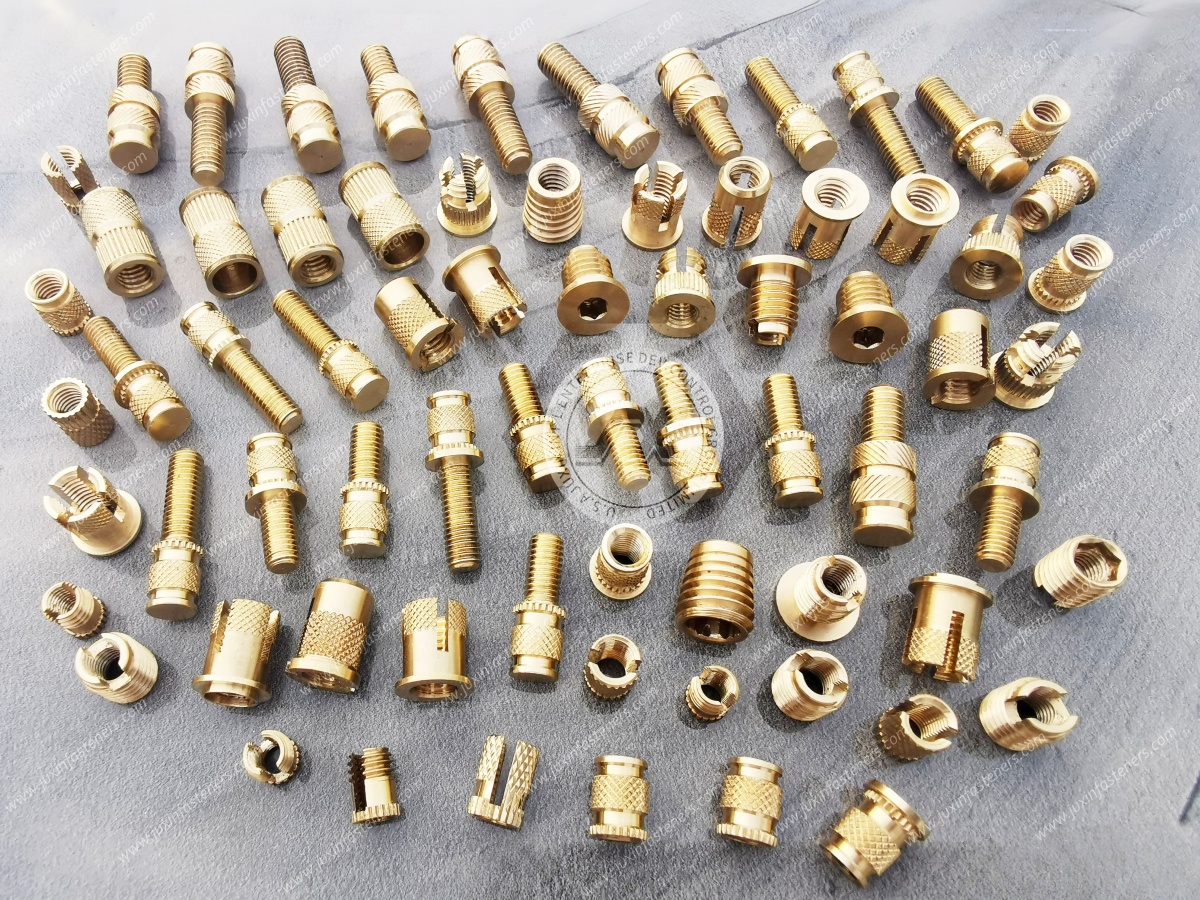
Depending on the design, those features may include:
Hexagonal external profiles
Barbs or retention fins
Straight knurls
Diamond knurls
Grooves
Slotted compressible bodies
Flanges
Pilot features
The correct geometry depends on the polymer, hole dimensions and required mechanical performance.
Common Commercial Names
Press-Fit Brass Threaded Inserts
Press-In Brass Threaded Inserts
Cold-Press Brass Inserts
Brass Thread Insert Nuts
Barbed Threaded Inserts for Plastics
Hexagonal Press-In Inserts
Solid Body Press-In Inserts
Knurled Brass Threaded Inserts
Threaded Inserts for Injection-Molded Plastics
These names describe related products but do not guarantee identical geometry or installation requirements.
Important Distinction
Press-fit installation is normally performed after the plastic component has been molded.
Molded-in installation places the insert inside the mold before the plastic is formed around it.
The two processes require different design and production considerations.
How Cold-Press Threaded Inserts Work
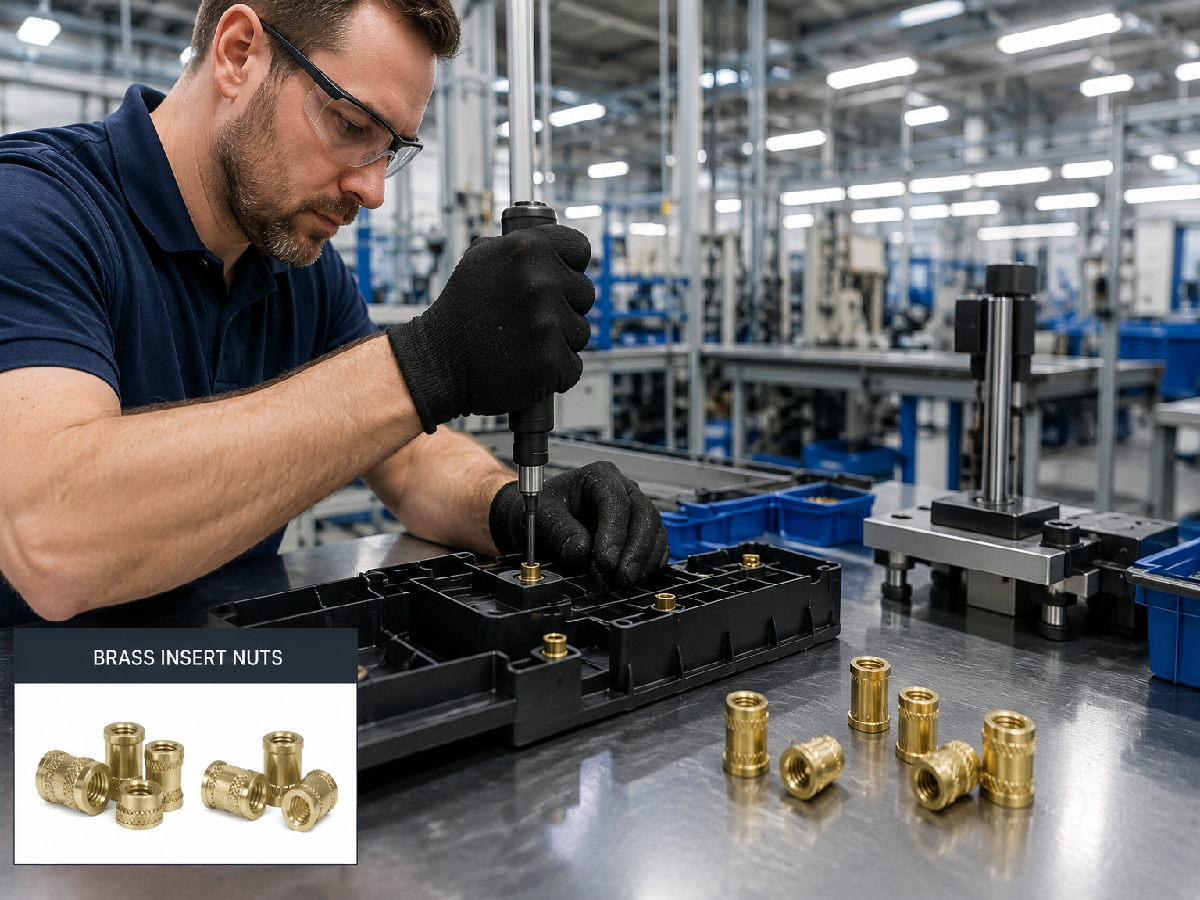
Cold-press installation uses controlled mechanical force to position the insert inside a prepared hole.
The insert's external features interact with the plastic to create retention.
Depending on the insert design, retention may involve:
Local plastic displacement
Interference fit
Engagement of barbs or fins
Resistance created by knurled surfaces
Elastic compression of a slotted insert body
The internal thread remains available for a mating screw.
Basic Installation Sequence
Mold or prepare the plastic component with the specified hole geometry.
Verify the hole dimensions and local boss condition.
Align the insert with the hole.
Support the plastic component using suitable fixturing.
Apply controlled installation force.
Stop at the specified installation depth.
Inspect the installed insert.
Perform agreed mechanical verification where required.
Why Cold Installation Can Be Attractive
The process does not require a dedicated heat-setting or ultrasonic insertion cycle.
This may simplify equipment selection and reduce certain process steps.
However, the actual manufacturing advantage depends on component geometry, required force, cycle time, scrap rate and inspection requirements.
Cold Pressing Does Not Mean Zero Plastic Stress
Mechanical installation displaces or deforms the surrounding polymer.
If the interference is excessive, the plastic boss may crack or develop residual stress.
Cold-press inserts therefore require careful coordination between the insert supplier, plastic component designer and assembly process engineer.
Hexagonal and Barbed Press-Fit Insert Designs
Some press-fit inserts use hexagonal external geometry with barbed retention features.
Hexagonal Profile
A noncircular external profile can help resist rotation when properly engaged with the surrounding plastic.
Barbs and Retention Fins
These features may improve resistance to axial withdrawal by mechanically engaging the host material.
Solid Body Construction
A solid body can provide a rigid metallic thread interface.
However, the surrounding plastic must accommodate the installation stresses.
Slotted Insert Construction
Some press-in inserts use a slotted body that compresses during installation.
This can change the insertion-force and retention behavior compared with a solid-body design.
Why Insert Geometry Must Match the Plastic
An aggressive barb may provide useful retention in one polymer but cause cracking in another.
A design intended for a relatively rigid thermoset may not be suitable for a softer thermoplastic.
The actual insert drawing and application conditions must be evaluated together.
Industry Reference: Press-In Insert Design
PennEngineering's SI® press-in insert portfolio includes hexagonal barbed, slotted, flanged, straight-knurled and solid-body designs.
The manufacturer distinguishes these configurations according to installation behavior and retention features.
This illustrates why the term "press-fit threaded insert" should not be treated as one universal design.
Press-Fit Versus Heat-Set Versus Molded-In Inserts
The installation method should be selected according to the plastic material, production process and required performance.
| Selection factor | Press-fit insert | Heat-set insert | Molded-in insert |
|---|---|---|---|
| Installation stage | After molding | After molding | During molding |
| Primary installation method | Mechanical pressing | Controlled heating and insertion | Plastic formed around insert |
| Deliberate local heating during insertion | No | Yes | Not a separate insertion operation |
| Main design concern | Interference and boss stress | Plastic flow and thermal process control | Insert positioning and molding quality |
| Equipment considerations | Press and fixturing | Heating and insertion equipment | Mold tooling and insert placement |
| Typical qualification need | Retention and cracking | Retention and thermal-process stability | Retention and molding consistency |
When Press-Fit May Be Preferred
The selected plastic supports mechanical insertion
Thermal insertion is undesirable
Post-mold installation is acceptable
The insert geometry provides sufficient retention
Assembly equipment can control insertion force and depth
When Heat-Set May Be Preferred
A compatible thermoplastic can flow around retention features
The application benefits from thermal insertion
The boss design and equipment support a controlled process
When Molded-In May Be Preferred
The insert can be positioned reliably during molding
A separate post-mold operation is undesirable
The molding process and insert design are compatible
No Method Is Universally Strongest
Retention performance must be demonstrated for the actual component.
Brass Material Selection for Press-Fit Inserts
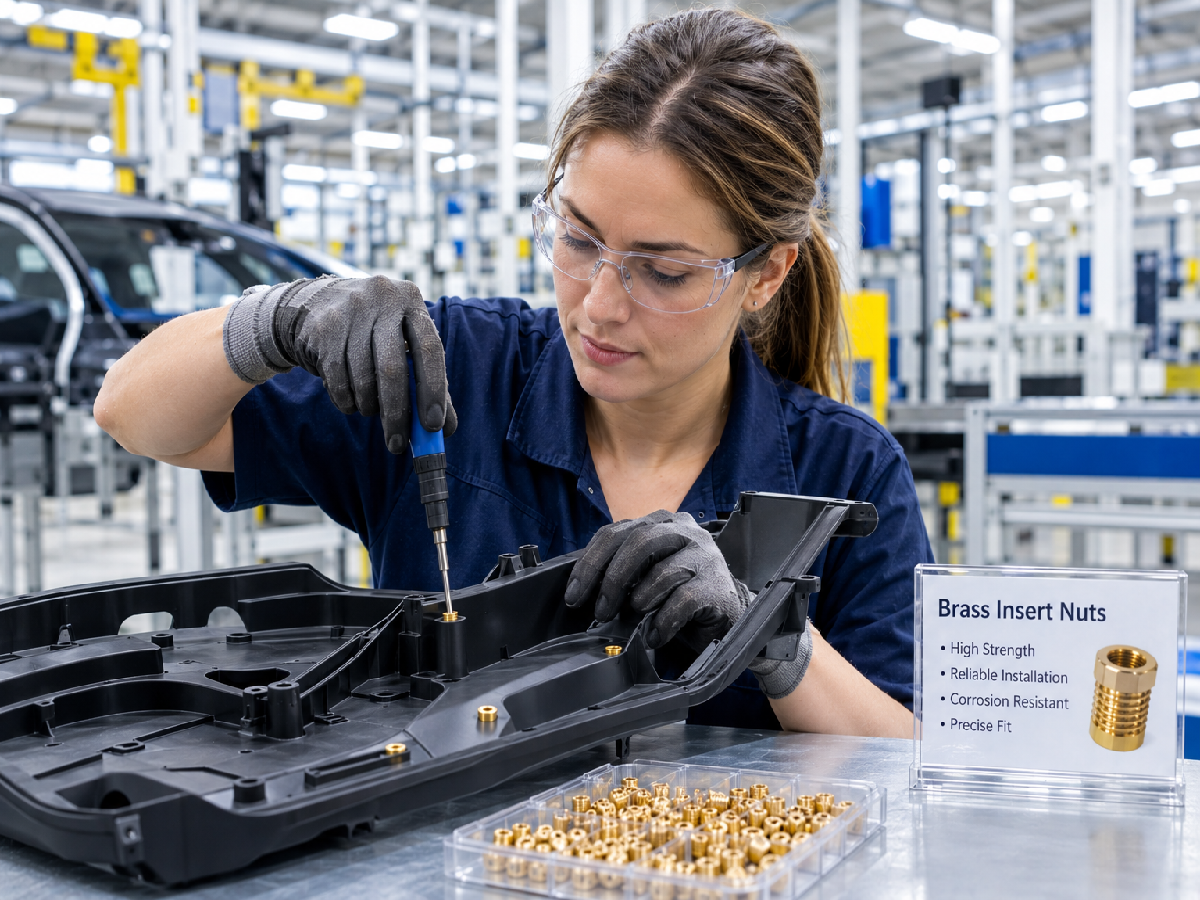
Brass is widely used for threaded inserts because it can be machined into precise internal threads and external retention features.
Potential Advantages
Good machinability
Durable metallic threads
Suitable dimensional precision
Corrosion resistance in many environments
Compatibility with various external geometries
Brass Alloy Selection
Brass alloys differ in composition, mechanical properties and lead content.
Some free-machining brass grades contain lead.
For medical equipment projects, the required alloy and material restrictions should be specified explicitly.
Why Brass Is Not Automatically Medical-Grade
A brass insert is not inherently:
Biocompatible
Sterile
Lead-free
Suitable for repeated sterilization
Resistant to every disinfectant
Approved for patient contact
These characteristics depend on the actual material, finished component and intended use.
Alternative Materials
Stainless steel or aluminum inserts may be considered where corrosion behavior, material restrictions, weight or mechanical requirements justify a different material.
Changing the insert material can also change installation and retention behavior.
The substitute must be validated.
Plastic Compatibility for Cold-Press Installation
The host polymer strongly influences press-fit performance.
Polycarbonate (PC)
May be used in selected medical equipment housings.
The design should consider local stress, cracking susceptibility and chemical exposure.
ABS and PC/ABS
May be suitable for certain equipment enclosures, depending on the resin grade and insert design.
Polypropylene (PP)
May be considered for selected applications, but its stiffness, creep behavior and retention performance require evaluation.
Polyamide (PA6 and PA66)
Moisture conditioning and resin grade can influence hole dimensions and mechanical behavior.
Glass-Filled Engineering Plastics
Reinforced materials may behave differently from unfilled resins.
Fiber content, fiber orientation and local molding conditions can influence cracking and retention.
Thermosetting Plastics
Some press-in insert designs are suitable for selected cured thermosets.
However, the material may have limited capacity to accommodate local deformation.
The insert geometry must be chosen accordingly.
Why Generic Material Names Are Insufficient
"Medical-grade plastic," "nylon" or "polycarbonate" does not define all relevant mechanical characteristics.
The OEM should identify the actual resin grade, fillers, conditioning and service environment.
Plastic Boss Design for Press-Fit Inserts
The boss is the local plastic structure that supports the insert.
It must resist both installation stresses and service loads.
Hole Diameter
The hole diameter must match the specific insert design.
An oversized hole may reduce retention.
An undersized hole may increase installation force and cracking risk.
Hole Shape
Some insert designs are intended for circular holes.
Others may use specific geometries.
The hole configuration must follow the selected insert's drawing.
Hole Depth
The hole must accommodate the insert and any required clearance.
The mating screw must not bottom out and create unwanted axial loading.
Boss Outside Diameter
Cold-press installation can create substantial local stresses.
Sufficient surrounding plastic is required to prevent cracking.
Boss Height
The boss must accommodate the insert length and support the intended load path.
Ribs and Reinforcement
Ribs may improve support when properly designed.
However, unsuitable geometry can create molding defects or stress concentrations.
Knit Lines and Molding Defects
Weak knit lines, voids or inconsistent local material conditions can reduce boss strength.
Why Cold-Press Inserts May Need More Surrounding Plastic
SPIROL's design guidance notes that cold-pressed inserts may require larger bosses or wall thicknesses because installation induces mechanical stresses.
This is particularly important when converting a design from heat-set insertion to press-fit installation.
Do Not Reuse Hole Dimensions from Another Insert
Two inserts with the same M8 internal thread can have different outside diameters, retention profiles and hole requirements.
The internal thread alone does not define the mounting hole.
Engineering Example: M8 Press-Fit Brass Insert
An OEM may request an M8 brass threaded insert for a medical equipment housing.
Before selecting the part, the engineering team should confirm:
M8 thread pitch
Insert outside diameter
Insert length
External hexagonal or barbed geometry
Brass alloy
Hole diameter and tolerance
Boss outside diameter
Boss height
Plastic resin grade
Installation force range established by testing
Required torque-out resistance
Required pull-out resistance
Mating screw length
Operating environment
Why M8 Is Not a Complete Specification
M8 identifies the nominal internal thread diameter.
It does not determine the insert's external dimensions, installation method or retention performance.
Installation Force: What Should Be Specified?
The original engineering challenge is not simply to achieve a high pressing force.
The goal is to install the insert consistently without damaging the plastic.
Force Too Low
Possible outcomes:
Incomplete insertion
Poor engagement
Incorrect seating
Reduced retention
Force Too High
Possible outcomes:
Boss cracking
Local plastic deformation
Insert damage
Tooling damage
Excessive residual stress
Force-Displacement Monitoring
A controlled press may record the relationship between applied force and insertion travel.
This can help identify:
Unexpected resistance
Incorrect hole dimensions
Misalignment
Incomplete seating
Abnormal installation conditions
Why There Is No Universal PC or PP Pressing Pressure
A single pressure value cannot be applied to every insert and polymer.
Installation behavior depends on the actual contact geometry, insert design, resin, hole dimensions and equipment.
Press force should be established through production-representative trials.
Installation Depth and Alignment
The insert must be installed to the depth required by the joint design.
Too Shallow
May interfere with the mating component or reduce effective seating.
Too Deep
May damage the boss, reduce useful thread access or create assembly problems.
Misaligned
May cause uneven loading, plastic damage or difficulty engaging the screw.
Practical Controls
Defined drawing datums
Correct hole position
Suitable component support
Guided insertion tooling
Controlled press travel
Inspection of installed position
No Universal 60%–70% Embedment Rule
Embedding depth should follow the insert geometry and approved assembly drawing.
It cannot be defined as a fixed percentage of plastic wall thickness for all designs.
Pull-Out Strength and Torque-Out Resistance
These are two different retention requirements.
Pull-Out Resistance
Measures resistance to axial withdrawal from the plastic.
Torque-Out Resistance
Measures resistance to rotation within the plastic.
Thread Strength
Concerns the internal metallic thread and mating fastener.
Boss Strength
Concerns the surrounding plastic structure.
Why One Test Is Not Enough
An insert may resist axial pull-out but rotate during screw tightening.
Another insert may resist rotation but crack the boss during installation.
The qualification plan should reflect the actual service loads.
How to Validate Retention
Use the specified insert installed in production-representative plastic components.
Record relevant conditions, including:
Resin grade
Hole dimensions
Insert dimensions
Installation process
Conditioning
Test method
Failure mode
Test results from a different resin or insert geometry should not be assumed to apply.
Preventing Jack-Out and Screw Bottoming
Jack-out is an important failure mode in plastic insert assemblies.
It can occur when the mating-part geometry or screw engagement creates an unintended load that displaces the insert.
Mating-Part Clearance Hole
The clearance hole must allow the screw to pass while providing the intended bearing and load path.
Screw Length
The screw must not bottom out in a blind hole or otherwise create damaging axial force.
Insert Seating
The installed insert must be positioned correctly relative to the mating component.
Headed Insert Considerations
A headed or flanged insert may be appropriate where the joint requires additional bearing area.
Why the Load Path Matters
The insert should carry the intended load rather than allowing the plastic to be compressed or pried in an uncontrolled manner.
Plastic Creep and Clamp Load
Plastic materials may deform under sustained loading.
This can affect joint preload over time.
A metallic internal thread does not eliminate creep in the surrounding plastic.
Compression Limiters
Where appropriate, a separate compression limiter can help manage compressive loads.
The threaded insert provides the thread.
The compression limiter provides a controlled compressive load path.
The two components should be designed together where the application requires both.
Medical Equipment Applications
Press-fit brass threaded inserts may be considered for selected non-patient-contact components in medical equipment.
Diagnostic Equipment
Analyzer housings
Instrument covers
Serviceable electronics enclosures
Mounting brackets
Laboratory Equipment
Equipment panels
Instrument housings
Control modules
Removable covers
Patient-Monitoring Equipment
Selected electronic enclosures
Auxiliary plastic housings
Serviceable mounting components
Medical Imaging Equipment
Auxiliary covers
Electronic module housings
Noncritical plastic mounting components
Portable Medical Equipment
Serviceable plastic housings
Internal equipment brackets
Selected accessory enclosures
Important Application Boundary
These examples do not establish suitability for patient-contacting components, sterile fluid pathways, implants or safety-critical medical connections.
Such applications require separate technical and regulatory evaluation.
Cleaning and Disinfection Compatibility
Medical equipment may be exposed to cleaning agents and disinfectants.
The metal insert and plastic component must be evaluated together.
Potential Risks
Plastic environmental stress cracking
Brass discoloration
Corrosion
Residue accumulation
Changes in retention performance
Damage from repeated exposure
Questions for the OEM
Which cleaning chemicals are used?
At what concentration?
What is the exposure time?
What temperature is expected?
How frequently will cleaning occur?
Is sterilization required?
Is the insert exposed or enclosed?
Cold Pressing Does Not Guarantee Cleanliness
A process without heating may avoid some thermal effects, but it can still generate particles or plastic debris.
Cleanliness must be controlled and verified according to the OEM's requirements.
Sterilization Compatibility
Not all medical equipment components require sterilization.
Where sterilization is required, the actual process must be specified.
Potential methods may include steam, ethylene oxide or radiation, depending on the finished device.
The material combination and joint performance must be evaluated after the relevant processing conditions.
A Brass Insert Is Not Automatically Sterilization-Compatible
Compatibility cannot be established solely from the material name.
Automated Cold-Press Assembly
Press-fit threaded inserts may be installed using manual, semi-automatic or automated equipment.
Possible Equipment Features
Controlled pressing force
Defined installation travel
Automatic feeding
Insert orientation control
Position monitoring
Force-displacement recording
Part-presence detection
Reject handling
The available functions depend on the actual production equipment.
Production Manager Considerations
Cycle time
Feeding reliability
Equipment uptime
Tooling maintenance
Changeover requirements
Scrap rate
Rework
Inspection time
Cost per accepted assembly
Why Faster Installation Is Not Always Cheaper
A shorter press cycle may still result in higher total cost if it creates cracking, misalignment or additional inspection requirements.
The process should be evaluated by accepted output, not insertion speed alone.
Pilot Production and Process Qualification
Before full production, evaluate the insert using representative components and intended equipment.
A practical qualification plan may include:
Dimensional inspection
Installation trials
Force-displacement review
Installed-depth verification
Pull-out testing
Torque-out testing
Mating screw assembly
Environmental exposure where required
Review of failure modes
Why Prototype Success Is Not Enough
A prototype may be produced under different molding, handling or installation conditions from mass production.
The approved process must account for normal production variation.
Common Press-Fit Insert Failure Modes
Plastic Boss Cracking
Possible causes:
Excessive interference
Insufficient boss material
Brittle resin behavior
Weak knit lines
Incorrect insertion alignment
Insert Rotation
Possible causes:
Insufficient engagement
Oversized hole
Incorrect insert geometry
Excessive tightening torque
Insert Pull-Out
Possible causes:
Inadequate barb engagement
Incorrect hole dimensions
Insufficient boss strength
Excessive axial loading
Incorrect Installation Depth
Possible causes:
Poor travel control
Inconsistent hole depth
Tooling wear
Incorrect setup
Insert Tilting
Possible causes:
Poor alignment
Inadequate component support
Incorrect feeding orientation
Hole-position variation
Thread Damage
Possible causes:
Incorrect mating screw
Cross-threading
Excessive assembly torque
Damaged insert thread
Contamination
Possible causes:
Machining residues
Burrs
Plastic debris
Handling or packaging contamination
Loss of Clamp Load
Possible causes:
Plastic creep
Stress relaxation
Incorrect load path
Unsuitable joint geometry
Root-Cause Analysis
A useful investigation separates the insert, plastic component and installation process.
Insert Factors
Material grade
External geometry
Thread accuracy
Length
Outside diameter
Burrs
Surface condition
Plastic Factors
Resin grade
Filler content
Hole dimensions
Boss geometry
Molding defects
Moisture conditioning
Process Factors
Press force
Installation travel
Tool alignment
Fixturing
Equipment condition
Assembly torque
Corrective actions should be verified through appropriate testing.
Quality Control for Press-Fit Brass Threaded Inserts
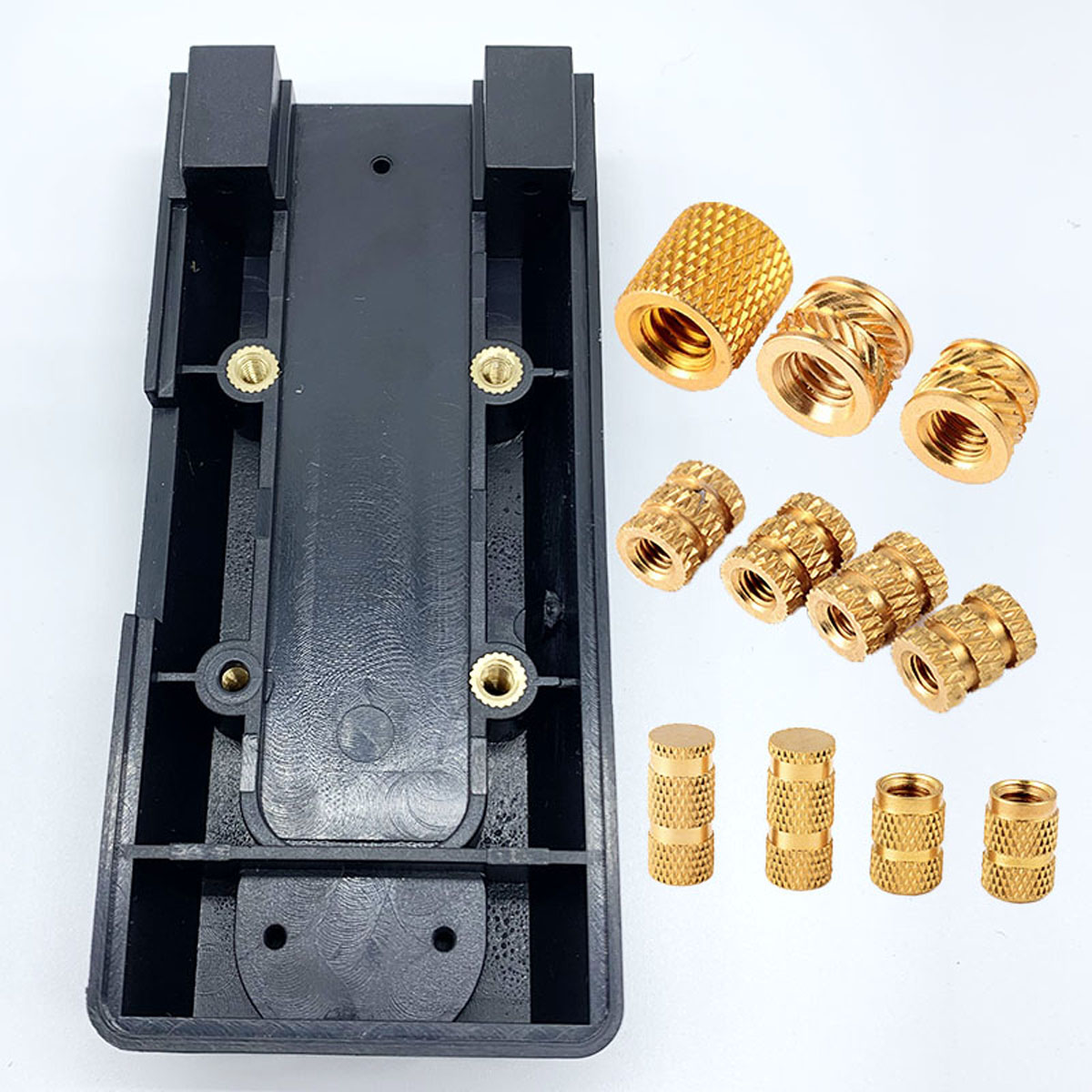
Quality control should cover both the insert and the installed assembly.
Incoming Insert Inspection
Depending on the drawing:
Brass alloy identification
Internal thread size and pitch
Thread tolerance
Overall length
Outside diameter
Hexagonal geometry
Barb or knurl dimensions
Surface finish
Burrs and visual defects
Plastic Component Inspection
Hole diameter
Hole depth
Hole position
Boss dimensions
Visible molding defects
Installation Process Control
Equipment setup
Press force
Insertion travel
Alignment
Fixturing
Process records
Final Assembly Inspection
Insert presence
Installation depth
Position
Visible plastic damage
Thread accessibility
Agreed mechanical testing
Documentation
Inspection records, material information and lot identification should be provided according to the agreed purchasing and quality requirements.
Medical Device Quality and Regulatory Considerations
Medical equipment OEMs may require supplier controls that go beyond ordinary industrial purchasing.
However, medical device quality requirements must be interpreted according to the finished device and the supplier's actual role.
ISO 13485:2016
Defines quality management system requirements for medical devices and related regulatory purposes.
FDA Quality Management System Regulation
The FDA QMSR became effective on February 2, 2026, incorporating ISO 13485:2016 into the relevant U.S. medical device quality system framework.
ISO 14971:2019
Provides a framework for medical device risk management.
ISO 10993-1:2025
Addresses biological safety evaluation within the medical device risk management process where relevant contact and exposure conditions apply.
Important Supplier Compliance Distinction
Supplying a brass threaded insert for a medical equipment housing does not automatically establish that the insert is a finished medical device.
Nor does it establish FDA approval, ISO 13485 certification, biocompatibility or sterilization validation.
Any required certification, documentation or testing must be confirmed for the specific project.
International Thread Standards
The internal thread should be specified according to the applicable thread system.
ISO 261
General-purpose ISO metric screw thread series.
ISO 965 Series
ISO metric screw thread tolerances.
ASME B1.1
Unified inch screw threads, including UNC and UNF.
Metric Thread Examples
M3 × 0.5
M4 × 0.7
M5 × 0.8
M6 × 1.0
M8 × 1.25
Unified Inch Thread Examples
4-40 UNC
6-32 UNC
8-32 UNC
10-24 UNC
10-32 UNF
1/4-20 UNC
These are thread designation examples, not confirmation that every size is available in every press-fit insert design.
Metric, UNC, UNF, BSW and BSF are not directly interchangeable.
Custom Press-Fit Brass Threaded Inserts for OEMs
A standard catalog insert may not match every medical equipment housing.
Custom drawing-based requirements may include:
Internal thread size and pitch
Overall length
Outside diameter
Hexagonal body dimensions
Barb or retention-fin geometry
Knurl configuration
Head or flange dimensions
Pilot features
Blind or through-thread configuration
Brass alloy
Surface treatment
Critical tolerances
Automatic feeding requirements
Why Customization May Be Necessary
A compact diagnostic instrument may have limited boss space.
A laboratory enclosure may require repeated service access.
An automated assembly line may need a specific insert orientation.
A medical equipment manufacturer may require defined material documentation or packaging controls.
The design should be based on the actual component and assembly process.
Supplier Development and Second-Source Qualification
Procurement and supply chain teams may evaluate alternative suppliers to improve sourcing flexibility or manage cost.
However, two press-fit inserts with the same internal thread are not automatically interchangeable.
Critical Comparison Points
Internal thread
Outside diameter
Overall length
Hexagonal or knurled geometry
Barb configuration
Brass alloy
Surface treatment
Hole requirements
Installation force behavior
Pull-out resistance
Torque-out resistance
Second-Source Qualification
Review the approved drawing.
Identify critical dimensions and materials.
Compare the proposed alternative.
Install samples into representative molded components.
Evaluate the required mechanical performance.
Confirm compatibility with production equipment.
Obtain customer approval where required.
Total Installed Cost
The total cost includes more than the insert's unit price.
It may include:
Insert purchasing
Plastic molding
Installation equipment
Cycle time
Tooling maintenance
Scrap
Rework
Inspection
Supplier qualification
Packaging and logistics
A lower unit price may not reduce the cost of the accepted assembly.
JUXIN FASTENERS Press-Fit Brass Insert Solutions
JUXIN FASTENERS supplies industrial threaded inserts and custom fastening components for plastic assemblies.
Relevant sourcing categories include:
Press-Fit Brass Threaded Inserts
Cold-Press Thread Insert Nuts
Barbed Threaded Inserts
Hexagonal Press-In Inserts
Knurled Brass Threaded Inserts
Custom Brass Threaded Bushings
Heat-Set Threaded Inserts
Ultrasonic Threaded Inserts
Molded-In Threaded Inserts
Specific geometries, materials, dimensions, inspection requirements and commercial terms require project-level confirmation.
Related JUXIN FASTENERS Products and Technical Resources
Custom Threaded Inserts for OEM Plastic Components
How to Choose Threaded Inserts for Injection Molded Parts
Threaded Inserts for Glass-Filled Plastics and Composites
Threaded Inserts for ABS, Nylon, PC, PBT and PEEK
These resources support material selection, custom geometry evaluation and injection-molded component design.
Frequently Asked Questions About Press-Fit Brass Threaded Inserts
What is a press-fit brass threaded insert?
It is a brass component mechanically installed into a prepared plastic hole to provide a reusable internal thread.
Is press-fit the same as molded-in?
No. Press-fit inserts are generally installed after molding, while molded-in inserts are positioned before plastic forming.
Do press-fit inserts require heating?
Conventional cold-press installation does not deliberately heat the insert or surrounding plastic.
Can press-fit inserts crack plastic?
Yes. Excessive interference or inadequate boss design can cause cracking.
Are hexagonal press-fit inserts better than knurled inserts?
Not universally. Performance depends on geometry, polymer and loading.
Can press-fit brass inserts be used in medical equipment?
They may be suitable for selected applications after appropriate engineering and quality evaluation.
Are brass inserts automatically medical-grade?
No. Material and application suitability must be established.
What is the best hole diameter for an M8 press-fit insert?
There is no universal hole diameter. It depends on the selected insert's outside geometry and the plastic material.
What pressing force should be used for PC or PP?
The required force must be established for the actual insert, polymer, hole and equipment.
What is the difference between pull-out and torque-out resistance?
Pull-out resistance concerns axial withdrawal, while torque-out resistance concerns rotation.
Does cold pressing eliminate thermal damage?
It avoids deliberately applying heat during installation but can still create mechanical stress and deformation.
Can press-fit inserts withstand sterilization?
Compatibility must be evaluated for the actual material combination and processing conditions.
Can an insert with the same M8 thread replace another insert?
Not automatically. External geometry, material, hole requirements and retention behavior must also match.
Can JUXIN FASTENERS evaluate custom press-fit inserts?
Yes. Drawing-based requirements may be submitted for technical and commercial evaluation.
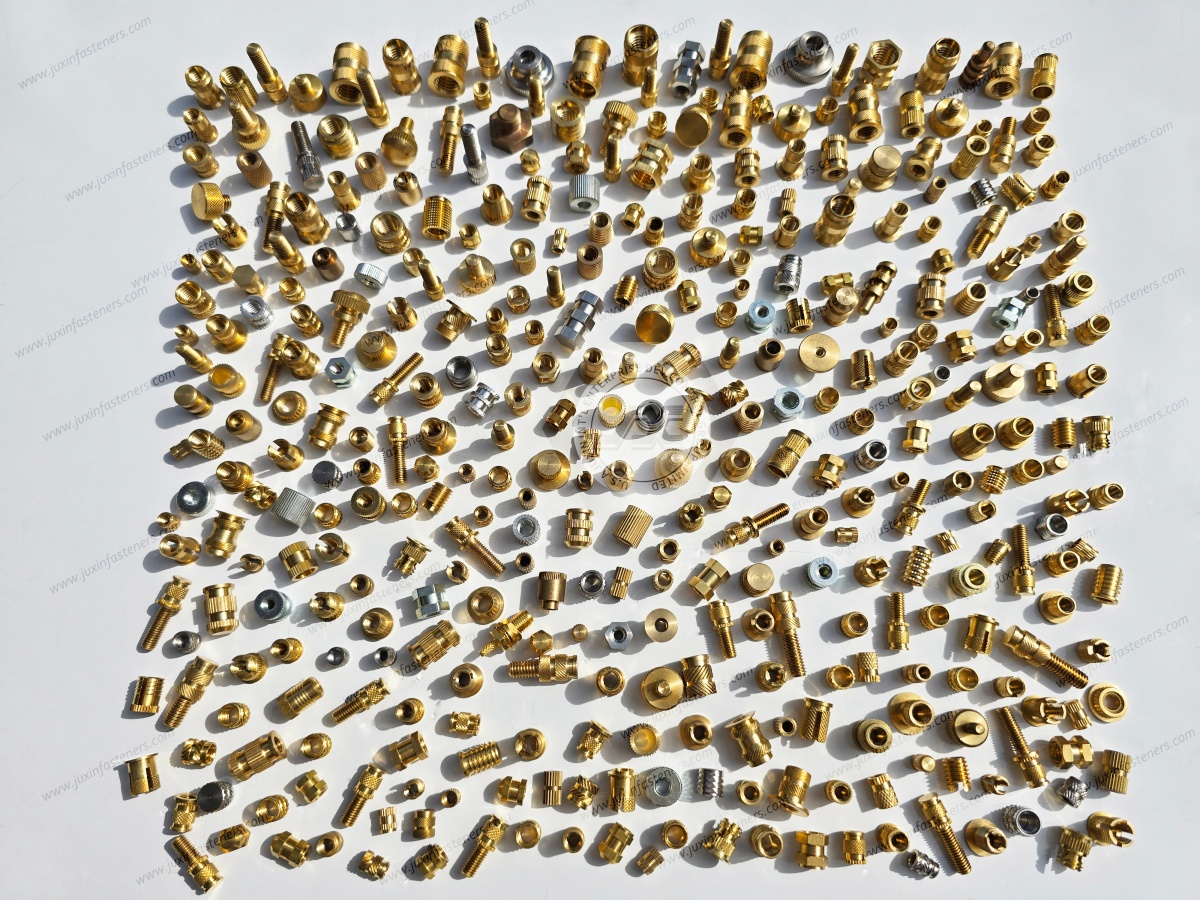
OEM RFQ — Press-Fit Brass Threaded Inserts for Medical Equipment
JUXIN FASTENERS welcomes inquiries from medical equipment manufacturers, plastic injection molding companies, design engineers,
manufacturing engineers, production managers, procurement specialists, supplier development teams and global supply chain managers.
For technical evaluation and quotation, please provide the following information where applicable.
Insert Specifications
2D engineering drawing
3D CAD model where available
Internal thread size and pitch
Metric or Unified inch designation
Overall length
Outside diameter
Hexagonal, barbed or knurled geometry
Head or flange configuration
Brass alloy
Surface treatment
Critical tolerances
Plastic Component Information
Resin grade
Filler content
Molded hole diameter
Hole tolerance
Hole depth
Boss diameter
Boss height
Wall thickness
Mating component geometry
Installation Requirements
Cold-press installation method
Installation equipment
Required seating depth
Force or travel monitoring requirements
Automatic feeding requirements
Production cycle considerations
Mechanical Requirements
Pull-out resistance
Torque-out resistance
Assembly tightening torque
Screw engagement
Repeated assembly requirements
Vibration or fatigue exposure
Temperature and humidity conditions
Medical Equipment Quality Requirements
Intended application
Cleaning or disinfection exposure
Sterilization requirements, if applicable
Material documentation
Cleanliness requirements
Traceability
Inspection and testing
Packaging requirements
Supplier change-control requirements
Commercial Requirements
Sample quantity
Initial order quantity
Estimated annual demand
MOQ expectations
Delivery schedule
Required documentation
Company: Juxin Fasteners
Website: https://www.juxinfasteners.com/
Email: info@juxinfasteners.com
Send your engineering drawings and application requirements to JUXIN FASTENERS for evaluation of press-fit brass threaded inserts,
barbed insert nuts, custom threaded bushings and OEM plastic fastening solutions.
The most reliable press-fit threaded connection begins with the correct insert geometry, compatible plastic boss design,
controlled installation process and verified assembly requirements.
Contact Us
Tel.:
+86 020 8621 0320
+86 020 3121 6067
E-mail:
Technical Support:
Navigation
SEND INQUIREY



